
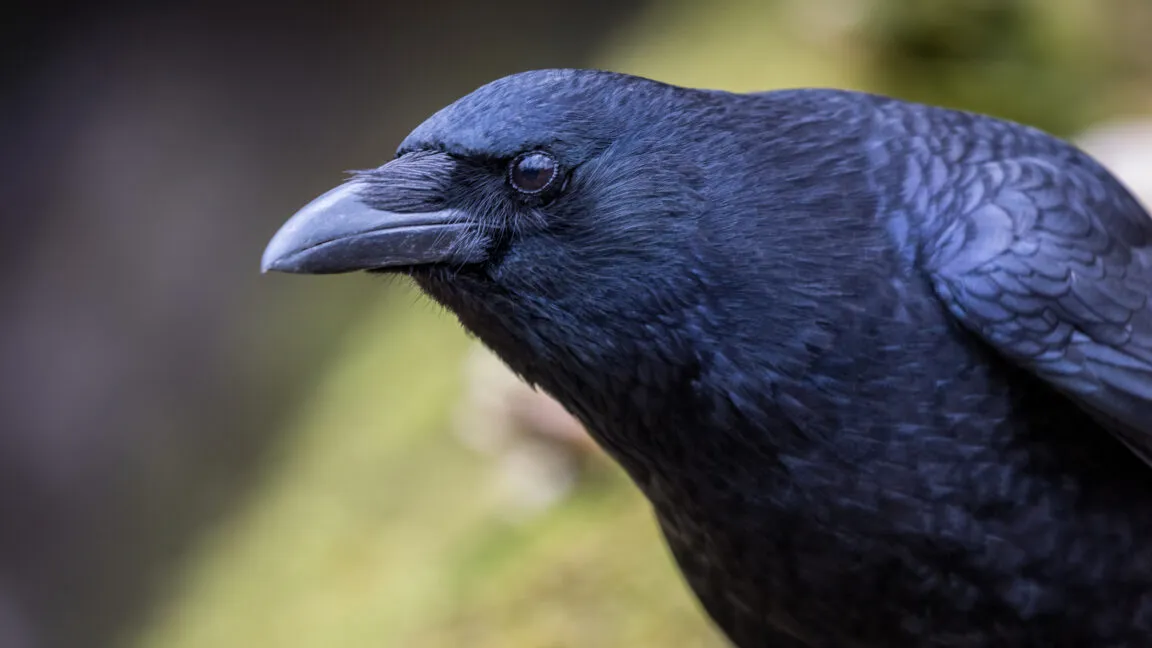
How do crows process visual information so rapidly?
Crows complete complex visual tasks in approximately 235 milliseconds, a speed that outpaces humans and monkeys by a significant margin. In the recent study conducted by Andreas Nieder and Philipp Schmidbauer, researchers utilized a random-dot-motion task—a standard method for measuring decision-making in primates. The task involves observing a cloud of flickering dots to determine their direction of movement. While primates typically require between 410 and 600 milliseconds to reach a conclusion, the crows demonstrated a much tighter and faster response window.
The researchers ensured the difficulty of the task was comparable by varying the 'coherence' of the dots. When 81 percent of the dots moved together, the task was simple; when only 3 percent moved coherently, it became nearly indistinguishable from random noise. Remarkably, the crows maintained high accuracy even at these low coherence levels, proving that their speed does not come at the expense of precision. They were not forced to be fast; rather, their natural, self-paced decision-making was inherently more rapid than the mammalian counterpart.
What is the role of the nidopallium caudolaterale in avian decisions?
The nidopallium caudolaterale (NCL) serves as the functional equivalent to the primate prefrontal cortex, acting as the primary site for high-level decision-making in birds. Although the structural organization of the avian brain differs fundamentally from the mammalian neocortex, the NCL performs nearly identical computational roles. While the mammalian cortex is built of stacked layers of cells, the avian NCL is composed of dense, non-layered clusters of neurons.
During the experiments, researchers recorded activity from 248 neurons within the NCL to observe how decisions are encoded. They found that a specific subset of these neurons—58 out of the 248 sampled—fired in direct correlation with the bird's eventual choice. These neurons began registering a 'decision variable' as early as 70 milliseconds after the visual stimulus appeared. This signal acts as a running tally of sensory evidence that climbs toward a threshold, mirroring the evidence-accumulation process seen in the primate neocortex.
Comparing Brain Architectures
The discovery that crows use the same mathematical logic as primates, despite having a non-layered brain, suggests a profound evolutionary convergence. Even though birds and mammals diverged over 360 million years ago, evolution appears to have arrived at the same physiological mechanism for decision-making twice. The NCL achieves the same results as the neocortex through a different structural arrangement, proving that complex cognition is not exclusive to layered mammalian brains.
Why are avian brains faster than mammalian brains?
The superior speed of the crow's brain is likely the result of a biological cascade rather than a single specialized mechanism. According to Andreas Nieder, the efficiency begins with the avian visual system, which is exceptionally sensitive to movement, and continues through the neurological processing and the subsequent motor response. This rapid-fire capability is driven by two primary physiological advantages: miniaturization and thermal regulation.
The first advantage is related to the physical constraints of flight. Because birds must remain lightweight, they pack a massive number of very small neurons into incredibly compact brains. This results in much shorter axons—the fibers that transmit electrical and chemical signals. Since longer pathways take more time to transmit data, these shorter 'lines' significantly accelerate the speed of communication between neurons.
The Impact of Body Temperature
The second major factor is the higher metabolic rate and body temperature of birds. While humans maintain a body temperature of approximately 36.6°C, birds often operate at temperatures between 41°C and 42°C. This elevated heat speeds up the fundamental chemistry of life. Every ion channel in the nervous system opens and closes more quickly, and neurotransmitters move through the synaptic cleft at an accelerated pace, creating a high-speed environment for neural computation.
Does the difficulty of a task affect crow reaction times?
While difficulty does influence the speed of decision-making in crows, the effect is far less pronounced than it is in primates. In mammals, a harder task typically leads to a significant increase in the time taken to reach a decision. In the carrion crows studied, reaction times only shifted from 220 milliseconds for the easiest tasks to 254 milliseconds for the hardest—a difference of just 34 milliseconds.
This narrow range might suggest that birds are working on a fixed internal timer, but the data suggests otherwise. A closer statistical analysis reveals that reaction times do still increase as the coherence of the dots decreases. The difference is simply that because the entire process occurs so much faster, the fluctuations caused by task difficulty are much harder to detect. The crows are not merely 'guessing' on a timer; they are actively accumulating evidence at a much higher velocity than mammals.
Frequently asked questions
How do crows compare to humans in decision-making accuracy?
Crows are as accurate as humans and monkeys when performing the random-dot-motion task. The research highlights that their increased speed does not result in a loss of precision, meaning they can process complex visual information and reach correct conclusions without the errors typically associated with rapid responses.
What is the difference between avian and mammalian brain structure?
The primary difference lies in the organization of the tissue. The mammalian neocortex is structured in stacked layers of cells, whereas the avian brain, specifically the NCL, is organized into dense clusters of neurons with no layering. Despite this structural divergence, the functional output remains similar.
Why does flight make bird brains faster?
Flight requires birds to be lightweight, which forces them to evolve smaller brains with extremely small neurons. This miniaturization results in shorter axons, which reduces the time required for electrical and chemical signals to travel between different parts of the brain.
Does higher body temperature affect bird intelligence?
Higher body temperature does not necessarily increase 'intelligence,' but it does accelerate the physiological processes required for thought. The higher temperatures in birds speed up ion channel activity and neurotransmitter movement, allowing for much faster neural signaling compared to mammals.
Is the study's sample size significant?
The study used two crows, which is a small sample. However, researchers note that in complex electrophysiology studies involving both behavior and brain recordings, using two subjects is a common standard, similar to the protocols used in primate research.
Key takeaways
- Crows process visual information in roughly 235 milliseconds, nearly twice as fast as primates.
- The avian nidopallium caudolaterale (NCL) functions similarly to the primate prefrontal cortex.
- Shorter axons in compact avian brains allow for faster signal transmission.
- Higher avian body temperatures accelerate chemical and neurological processes.
- Crows maintain high accuracy even when visual information is extremely minimal.
Synthesis of avian cognitive efficiency
The research into crow decision-making speed provides a fascinating look at convergent evolution. By achieving primate-level cognitive accuracy through a completely different neurological architecture, crows demonstrate that there are multiple biological paths to high-speed intelligence. The combination of compact neural pathways and high-temperature metabolic processes allows birds to operate in a 'fast lane' that mammals cannot match. While the study is limited by its small sample size, it fundamentally shifts our understanding of how brain structure dictates the speed of thought.
