
Why are AI storage costs being overlooked in infrastructure planning?
Most enterprise AI strategies prioritize the visible costs of compute, such as high-performance GPUs and the massive power requirements needed to run them. However, this focus creates a blind spot regarding the data generated after a model responds to a user. Unlike AI training, which is a finite project with a clear beginning and end, AI inference is a continuous process that leaves a permanent digital footprint with every single request.
Training runs are predictable; they are intensive, time-bound, and can be budgeted as discrete capital expenditures. In contrast, inference is an ongoing operational reality. Every prompt, image, or video generated adds to a growing mountain of logs, cached context, and safety records. Because these costs compound over time, they often bypass the initial scrutiny applied to silicon procurement and energy consumption.
The disconnect between training and inference budgets
The fundamental difference lies in the lifecycle of the workload. A training cycle consumes massive resources to build a model, but once the model is deployed, the primary resource focus shifts to the accelerators. However, the data produced during the deployment phase—the inference stage—never stops accumulating. If an organization budgets for AI as "compute plus a rounding error for storage," they risk a significant budget shortfall within 12 to 18 months as the data volume scales disproportionately to the compute cycles.
How much data does AI inference actually leave behind?
The scale of the back-end data footprint is often many times larger than the visible output provided to the end user. This discrepancy is most visible in generative video workloads, where the secondary data required to support a single clip can dwarf the file itself.
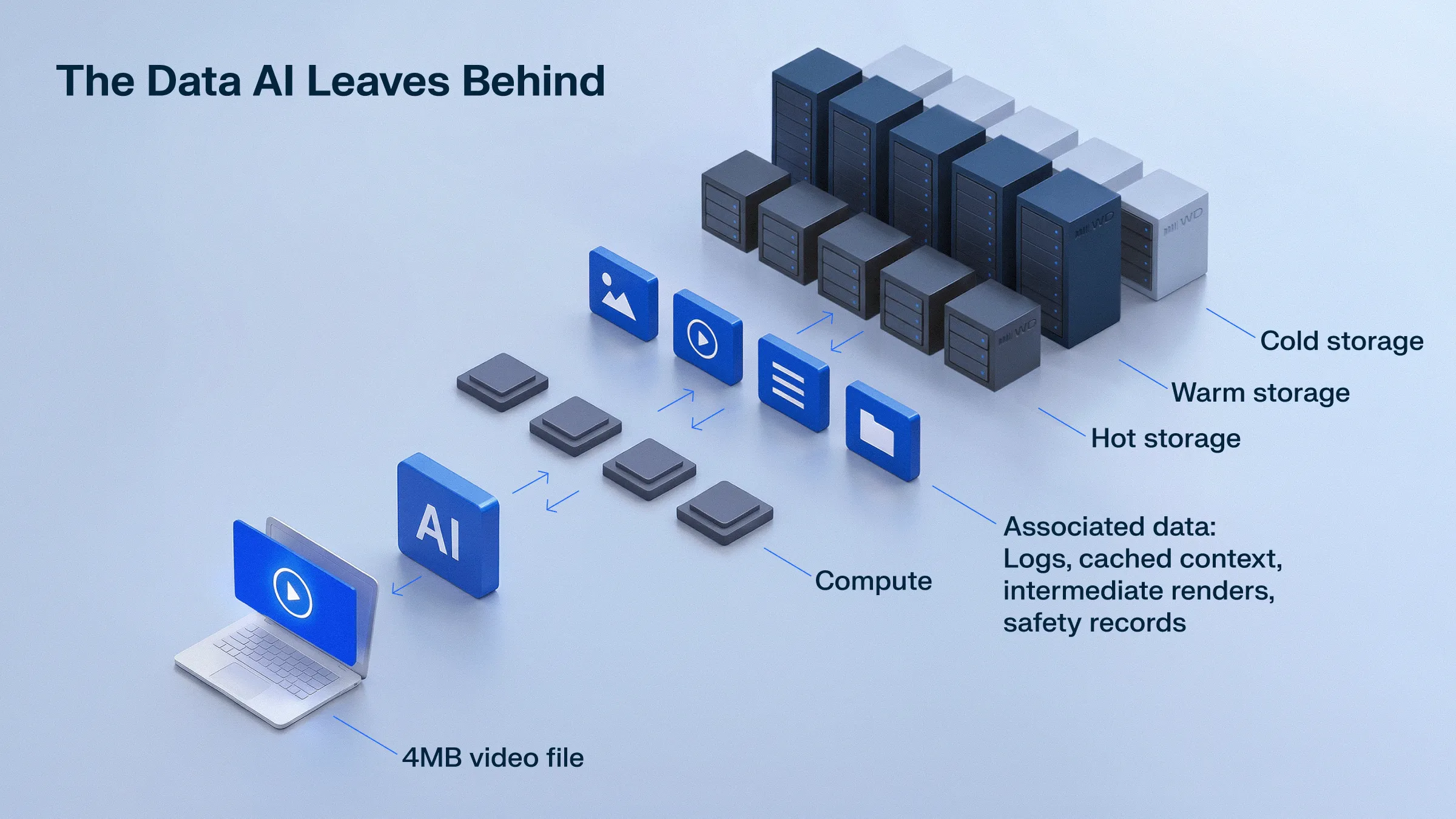
According to internal measurements from WD, an 8-second video clip—which might appear to a user as a 3.97MB 720p file—can leave more than 500MB of associated data on the back end. This massive increase is driven by several factors:
- Logs and metadata: Detailed records of the generation process.
- Cached context: Data kept to speed up subsequent related queries.
- Immediate renders: Intermediate files used during the generation process.
- Backups and safety records: Essential files for compliance and error recovery.
This represents a 130x increase over the perceived output size. For enterprises moving toward higher resolutions and longer durations, the back-end footprint can quickly escalate into hundreds of gigabytes per individual clip.
What is the impact of rising generative AI data volumes?
The surge in data volume is already a measurable reality for IT decision-makers. A recent WD-sponsored IDC global white paper, which surveyed 763 IT and business decision-makers, highlighted the rapid expansion of data footprints caused by generative AI.
The survey found that nearly 95% of respondents reported an increase in data volume due to generative AI over the last 12 months. Furthermore, approximately 61% of those surveyed reported that their data growth was 25% or higher. This rapid expansion places immense pressure on existing data center architectures.
The risk of GPU idle time
One of the most critical consequences of insufficient storage planning is the impact on compute efficiency. As noted by a senior product manager of a hyperscale cloud service provider in the IDC report, storage is an optimization tool for keeping GPUs active. If the storage infrastructure cannot deliver data fast enough, the most expensive assets in the data center—the GPUs—sit idle. This idle time results in massive, unnecessary expenditures, as the cost of an idling GPU can be as high as the cost of one lacking a chip entirely.
How does the AI data lifecycle change storage requirements?
Traditional data management often assumes that once data is processed, it moves into a cold archive and is rarely accessed again. AI is breaking this paradigm by turning archived data into active assets. Information that was once considered "dead" storage is increasingly being reused as input for future workloads through techniques like Retrieval-Augmented Generation (RAG).
This shift requires a more dynamic approach to storage. Organizations can no longer rely solely on high-performance, expensive "hot" tiers. Instead, they must manage a complex lifecycle that includes:
- Performance tiers: For immediate, high-speed access during active inference.
- Capacity tiers: Using high-density technologies like HDDs to provide a cost-effective foundation for the vast volumes of data that must be retained.
- Retrieval-optimized archives: Ensuring that even "cold" data can be retrieved quickly enough to support RAG pipelines.
The IDC survey supports this need, with 96% of respondents anticipating a requirement for faster archive retrieval to support inference or RAG workflows.
How can enterprises build economically scalable AI capacity?
To avoid the "storage bottleneck," enterprises must move away from viewing storage as a secondary concern and instead integrate it into their core AI architecture. Building for economic scalability means balancing performance with total cost of ownership (TCO) as data persists and compounds.
Effective scaling requires a tiered strategy where power consumption, reliability, and density are optimized for each stage of the data's life. Rather than just buying more drives, organizations should focus on setting intelligent retention policies based on the strategic value of the data rather than just its original storage cost. This involves treating archives as active components of the AI ecosystem.
Three essential questions for AI budgeting
Before the next budget cycle, CIOs and CFOs should address three critical questions to close the gap between compute and storage planning:
- What is our data retention policy for AI-generated content, and who is responsible for it? Establishing ownership ensures that data growth is managed proactively.
- Is our storage procurement tied to training performance or the actual data lifecycle? Procurement must account for the continuous accumulation of inference data, not just the temporary spikes of training.
- If our AI usage doubled next year, would our storage costs double or grow exponentially? Understanding the non-linear relationship between usage and storage is vital for long-term financial stability.
Key takeaways
- AI inference demand is projected to grow at a 35% CAGR through 2030, outpacing training growth.
- Generative video can create a back-end data footprint 130 times larger than the user-facing file.
- Nearly 95% of IT decision-makers report increased data volumes due to generative AI.
- Insufficient storage capacity leads to expensive GPU idle time, impacting overall ROI.
- Modern AI requires high-capacity, cost-effective storage like HDDs to support RAG and data reuse.
FAQ: AI storage costs
Why is inference data more difficult to budget than training data?
Training data is part of a finite, project-based cycle that has a clear start and end point. Inference, however, is an ongoing operational process. Every single request generates new logs, metadata, and safety records that accumulate indefinitely, creating a continuous and compounding cost that is harder to forecast.
What is the relationship between storage and GPU efficiency?
Storage acts as a feeder for compute resources. If the storage infrastructure is too slow or lacks sufficient capacity, the GPUs must wait for data to arrive. This idle time is extremely expensive, as organizations continue to pay for high-performance compute power that is not actively performing tasks.
How does Retrieval-Augmented Generation (RAG) affect storage needs?
RAG requires the ability to quickly retrieve relevant information from vast datasets to provide context to an AI model. This means that even older, archived data must be stored in a way that allows for relatively fast retrieval, moving away from traditional "write-once, read-never" archival methods.
Why is video generation specifically mentioned as a storage risk?
Video generation creates a massive amount of "hidden" data. While a user sees a small video file, the back end must store renders, context, and safety logs. For an 8-second clip, the back-end data can be over 500MB, which is 130 times the size of the actual video file.
What technologies are best for managing the AI data lifecycle?
A tiered approach is most effective. High-performance tiers are needed for active inference, while high-capacity, cost-effective technologies like HDDs are essential for the massive volumes of data that accumulate in warm and cold tiers, especially when that data is slated for reuse in RAG.
Conclusion
The transition from AI training to large-scale inference marks a fundamental shift in data center economics. While the industry has focused heavily on the immediate requirements of GPU clusters, the compounding nature of inference-generated data presents a looming infrastructure challenge. As the data footprint grows—often by orders of magnitude beyond the visible output—organizations must evolve their budgeting and architectural strategies. By treating storage as a dynamic, strategic asset rather than a secondary expense, enterprises can ensure that their AI investments remain economically sustainable and that their compute resources remain fully utilized.