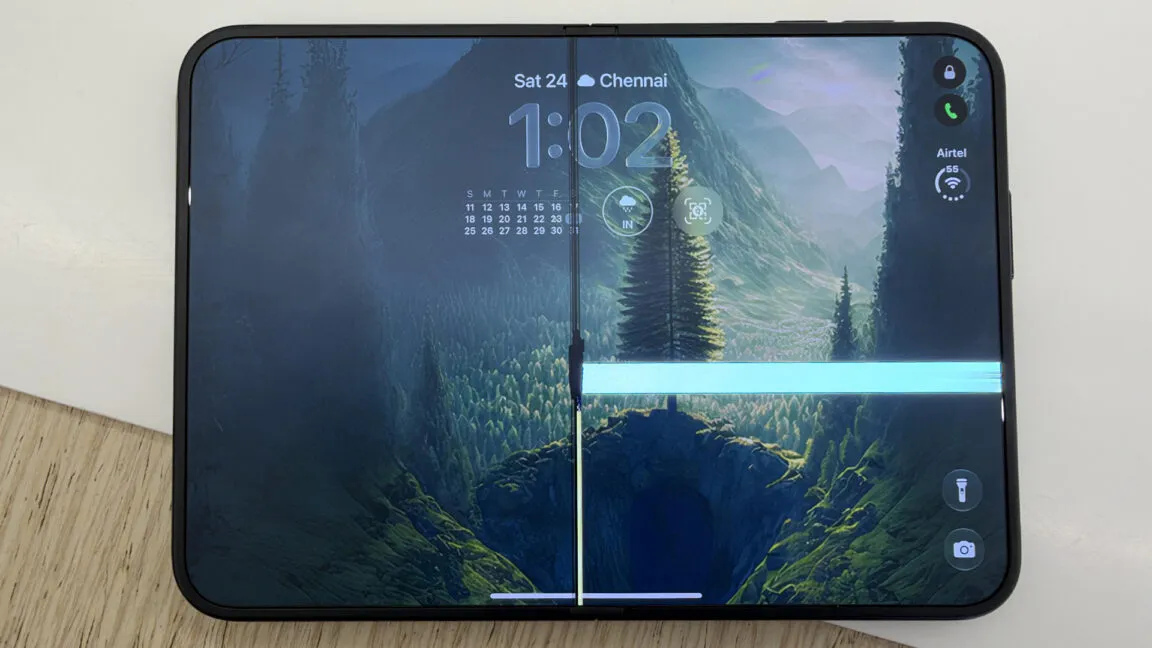
What are the symptoms of the iPhone Duo screen failure?
The primary symptom of the iPhone Duo screen failure is the appearance of permanent, bright lines across the internal OLED panel. Users report that these lines typically originate just below the midpoint of the display and extend toward the bottom and right edges of the screen. In some instances, dead pixels also form along the crease, stretching from the top of the device down to the area where the bright lines begin.
This specific type of visual defect is a hallmark of OLED panel damage. When the physical layers of the display are compromised, the pixels lose their ability to regulate voltage correctly. This leads to two distinct failure modes:
- Over-voltage: Pixels receive full driving voltage, causing them to stay permanently lit at maximum brightness.
- Under-voltage: Pixels receive no voltage, resulting in completely black, dead spots on the display.
The timing of these failures is particularly concerning for consumers. While many units appear to fail within a single day of operation, some users have reported hardware degradation after only a few opening and closing cycles, sometimes before the initial device setup was even completed.
How does the hinge mechanism contribute to the damage?
Preliminary investigations by hardware experts suggest that the iPhone Duo's hinge mechanism is likely the root cause of the display issues. While the device features a wide ribbon cable with "accordion-like pleats," initial analysis indicates the problem is not simply cable interference, but rather a mechanical fault within the hinge itself.
Users have noted physical irregularities during the folding process, including unusual resistance and audible clicking sounds when the phone is closed. These tactile and auditory cues suggest that the internal components are not moving smoothly as intended.
iFixit's CT scan findings
According to a teardown and CT scan analysis by iFixit, the point of failure is located just below where the ribbon cable passes through the hinge. The scans reveal that the width of the supporting hinge mechanism changes significantly at this specific junction, which points toward a mechanical misalignment. This narrowing of the hinge structure appears to create a physical bottleneck during the folding motion.
The impact of mechanical stress on OLED panels
The most probable theory involves the support bar within this narrowed section of the hinge. If this bar becomes stuck or fails to drop sufficiently, it cannot accommodate the "waterdrop" bend required by the OLED panel when the device is closed. This lack of clearance forces the hinge to apply direct, concentrated pressure to the display matrix. Because OLED panels are sensitive to physical stress, this continuous pressure eventually causes the catastrophic pixel failures reported by users.
What is the cost and difficulty of repairing an iPhone Duo?
Repairing an iPhone Duo affected by screen failure is expected to be an extremely expensive endeavor for consumers. Because the damage occurs within the layers of the OLED panel itself, the only viable solution is a complete replacement of the internal display assembly.
Current estimates suggest that swapping the screen on an iPhone Duo could cost approximately half the original purchase price of the device. Given that the iPhone Duo retails for $2,000, a single repair could cost upwards of $1,000. This high barrier to repair makes the hardware flaw particularly devastating for early adopters.
While some customers have successfully obtained replacements through Apple retail stores, there are concerns regarding the availability of spare parts. If the failure rate is widespread, Apple may face significant supply chain pressure to provide replacement units for the defective hardware.
How does this compare to previous foldable phone failures?
Apple is not the first major manufacturer to encounter significant hardware hurdles during the launch of a foldable device. The industry has seen similar patterns of failure, most notably with the original Samsung Galaxy Fold released in 2019.
The Samsung Galaxy Fold's issues were primarily caused by a design that allowed dust and small particles to enter the hinge, subsequently damaging the screen from underneath. This led to a significant delay in the product's release as Samsung re-engineered the hinge to be more resilient. While Samsung's subsequent foldable generations have faced occasional issues, they have generally avoided the immediate, widespread unboxing failures seen with the iPhone Duo.
The scale of Apple's current issue remains unconfirmed. However, because Apple operates at a much larger volume than most specialized foldable manufacturers, even a statistically low failure rate could result in a massive number of affected devices and significant social media visibility.
Frequently asked questions
What causes the bright lines on the iPhone Duo screen?
The bright lines are caused by physical damage to the OLED matrix, likely due to pressure from the hinge. This damage prevents pixels from regulating voltage, causing them to stay stuck at maximum brightness. This is a permanent hardware defect that cannot be fixed via software updates.
Can the iPhone Duo hinge issue be fixed with a software update?
No, the issue is a mechanical hardware defect involving the hinge alignment and physical pressure on the display. Software cannot correct the physical misalignment of the hinge or the resulting structural damage to the OLED layers. A physical hardware replacement is required.
How much does it cost to replace an iPhone Duo screen?
Replacing the screen on an iPhone Duo is expected to cost roughly half the price of the phone. With a retail price of $2,000, users should prepare for repair costs in the vicinity of $1,000, depending on official service pricing and part availability.
Is the iPhone Duo hinge defect a known issue for Apple?
As of the current reports, Apple has not officially acknowledged the hardware flaw. While users and independent researchers like iFixit have identified potential mechanical causes, the company has yet to issue a formal statement or a recall regarding the hinge design.
Why do some screens fail immediately after unboxing?
Some screens fail almost instantly because the mechanical misalignment in the hinge applies continuous stress to the OLED panel. Even a few folding cycles can trigger the failure if the hinge mechanism does not allow enough clearance for the screen's bend.
Key takeaways
- iPhone Duo users report OLED damage featuring bright lines and dead pixels.
- Failures often occur within hours or days of the initial device setup.
- iFixit analysis suggests hinge misalignment causes excessive pressure on the display.
- Replacing the damaged OLED screen may cost up to $1,000.
- The issue mirrors historical challenges faced by other foldable phone manufacturers.
The outlook for Apple's foldable hardware
The emergence of these hardware failures poses a significant challenge to Apple's entry into the foldable market. While the iPhone Duo represents a major technological leap for the company, the precision required for a folding mechanism leaves very little margin for error. If the hinge misalignment is indeed a fundamental design flaw, Apple may be forced to undergo a redesign process similar to the one Samsung implemented in 2019. For now, the focus remains on whether Apple can manage the replacement demand and whether a hardware revision will be necessary to restore consumer confidence in their first foldable device.