How will new NHTSA regulations affect autonomous vehicle identification?
The National Highway Traffic Safety Administration (NHTSA) has introduced a proposal to establish specific equipment standards that would help the public identify when a vehicle is in autonomous mode. A central component of this proposal is the use of cyan (blue-green) lighting to signal autonomous operation, particularly when no human occupant is monitoring the road. While the agency is not currently mandating these specific colors, the proposal serves as a strong suggestion for industry standardization.
The proposed specifications include details on where these lights should be mounted, the specific color they must emit, and the method of activation. According to the NHTSA, the lights should remain steadily illuminated rather than flashing and must be visible from the front, rear, and both sides of the vehicle. Additionally, the proposal seeks to modernize safety standards by removing requirements for manual controls for certain functions, such as turn signals, high beams, and hazard lights, in vehicles designed for autonomy.
Modernizing Federal Motor Vehicle Safety Standards
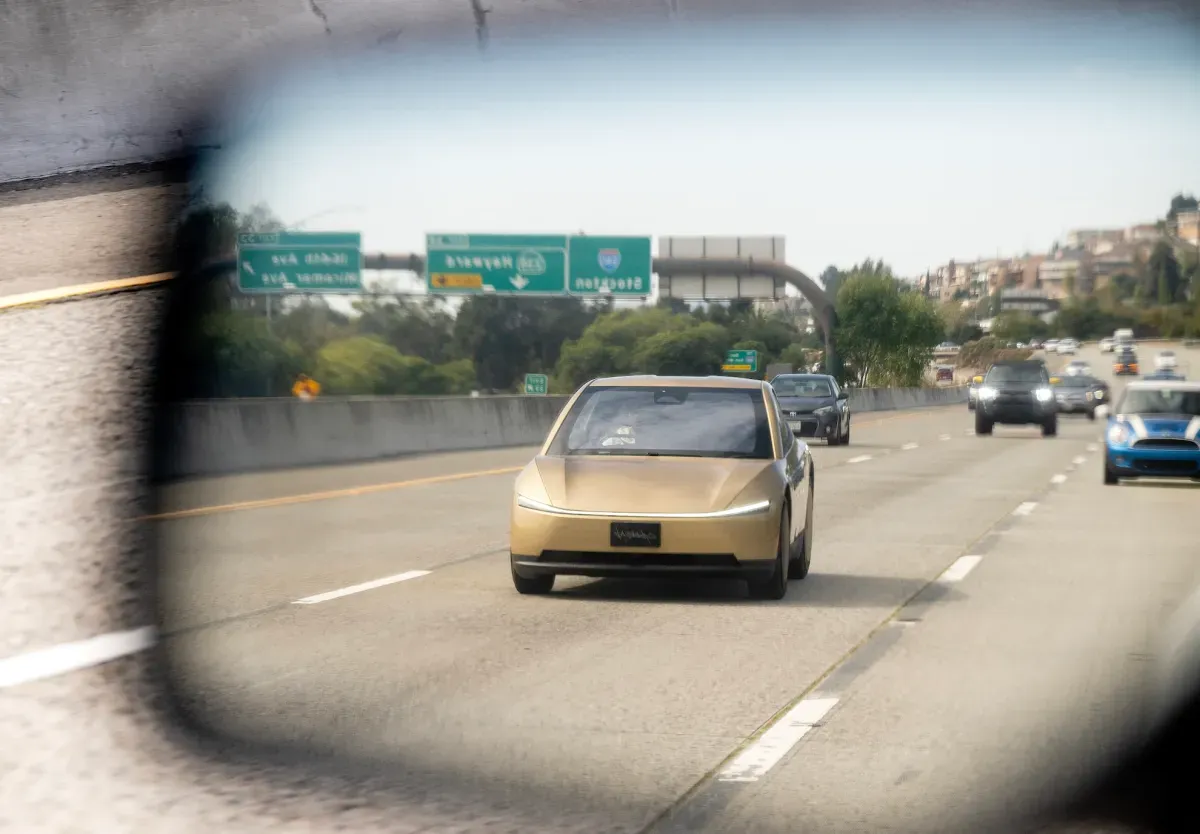
These changes are part of a broader effort to update Federal Motor Vehicle Safety Standards (FMVSS) to accommodate next-generation transport. Current rules were largely designed for human-driven cars and do not easily account for vehicles like the Tesla Cybercab or Zoox robotaxi, which lack traditional hardware like steering wheels, pedals, and side mirrors. NHTSA administrator Jonathan Morrison noted that the agency is working on a federal automated vehicle framework to balance rapid adoption with public safety.
What is GM's strategy for autonomous and AI integration?
General Motors (GM) is undergoing a massive technological overhaul to transition from a traditional automaker to an AI-centric mobility provider. At its recent GM Forward event, the company detailed plans to redesign the electrical and computational architecture of its future fleet. This transformation is intended to deliver faster software updates and more sophisticated automated driving capabilities.
A key milestone in this roadmap is the 2028 debut of the Cadillac Escalade IQ, which will feature a custom, conversational AI assistant designed to replace the long-standing OnStar service. Furthermore, GM plans to roll out an autonomous highway driving feature in 2028. This feature is intended to allow drivers to operate hands-free and eyes-off the road without the immediate requirement to intervene, a significant step toward full autonomy.
To accelerate these developments, GM has implemented enterprise AI across its corporate structure. The company aims to use these tools to reduce its traditional four-to-five-year vehicle development cycle by half. This aggressive timeline suggests GM is positioning itself for a direct confrontation with tech-native competitors rather than merely reacting to them.
Why did Rivian acquire Third Dimension?
Rivian has expanded its autonomous capabilities through the acquisition of Third Dimension, a U.K.-based startup specializing in AI-driven 3D world generation. The startup, which was founded by experts from the gaming and autonomous vehicle sectors, uses AI to convert images and video into lifelike three-dimensional environments. This technology is critical for the advancement of high-fidelity simulation.
According to Rivian's head of autonomy, James Philbin, the acquisition is a strategic move to close the "sim-to-real gap." This refers to the technical discrepancy between data collected in simulated environments and the actual physical world. By improving the accuracy of simulations, Rivian can train its autonomous systems more effectively in virtual settings before deploying them on real roads.
While the financial terms of the deal were not disclosed, industry analysts point to Third Dimension's previous $7 million seed round and its team of approximately 15 engineers as indicators of the scale. Because the deal did not trigger a mandatory SEC filing for material information, it is likely a targeted, mid-sized acquisition aimed at specific technical expertise.
How is the global robotaxi market evolving?
The competition for robotaxi dominance is expanding across diverse geographic and technological fronts. In Kazakhstan, the ride-hailing platform inDrive has signed a memorandum of understanding with Chinese firm Pony.ai and Nvidia to test robotaxis starting in 2027. This partnership represents a significant push to bring autonomous ride-hailing services to new international markets.
In the United States, Waymo continues its expansion strategy. The company is currently scaling its operations in existing cities and preparing to launch a robotaxi service in Madrid, Spain, with an expected opening in 2027. Waymo has also integrated into urban transit hubs, such as providing shuttle services to and from Harry Reid International Airport in Las Vegas.
What role does AI play in Tesla and SpaceX's current performance?
Tesla and SpaceX are increasingly becoming AI-centric companies, though their financial profiles show diverging trends. Recent reports indicate that SpaceX's AI business is a major revenue driver, generating $7.5 billion and accounting for 52% of the company's total income. Meanwhile, Tesla is heavily pivoting toward robotics and autonomy to offset flat revenue and declining profits.
Despite a 43% year-over-year drop in profits, Tesla is doubling down on its AI roadmap. The company has begun production of its Optimus humanoid robot and continues to develop its Full Self-Driving (FSD) software. Tesla also aims to begin selling its Cybercab to customers by the end of the year, marking a critical test for its autonomous vehicle ambitions.
The Tesla-SpaceX Merger Discussions
Adding to the market volatility, Elon Musk has indicated that the boards of Tesla and SpaceX have formed special committees to review a potential merger. While specific details remain undisclosed, the move has intensified speculation regarding the consolidation of Musk's AI and aerospace empires.
Frequently asked questions
What color would autonomous vehicles use under the NHTSA proposal?
The NHTSA proposal suggests using cyan (blue-green) lights to signal that a vehicle is operating in autonomous mode. These lights would be intended to remain steadily illuminated and would need to be visible from the front, rear, and sides of the vehicle to ensure public awareness.
When will GM's new AI-integrated vehicles arrive?
GM plans to debut its overhauled electrical and computational architecture with the Cadillac Escalade IQ in 2028. This same year, the company also intends to launch an autonomous highway driving feature that allows for hands-off and eyes-off operation by the driver.
What is the "sim-to-real gap" in autonomous driving?
The "sim-to-real gap" refers to the technical discrepancy between data generated in a simulated virtual environment and the actual data encountered in the physical world. Companies like Rivian use advanced 3D simulation technology to minimize this gap, ensuring AI training is more accurate.
Is Tesla's Cybercab already available for purchase?
No, the Cybercab is not yet available. Tesla has stated its intention to begin selling the Cybercab to customers by the end of 2026, as part of its broader push toward autonomous transportation and robotics-focused revenue streams.
How is Waymo expanding its service area?
Waymo is expanding by increasing its presence in currently active cities and entering new international markets. For example, the company has announced plans to launch a robotaxi service in Madrid, Spain, with an anticipated rollout in 2027.
Key takeaways
- NHTSA proposes cyan lighting to identify autonomous vehicles to the public.
- GM aims to debut its AI-driven vehicle architecture with the 2028 Cadillac Escalade IQ.
- Rivian acquired Third Dimension to improve 3D simulation and close the "sim-to-real gap."
- SpaceX's AI business now generates $7.5 billion, representing 52% of its income.
- Waymo plans to launch robotaxi services in Madrid by 2027.
The future of autonomous mobility
The autonomous vehicle landscape is shifting from experimental testing toward standardized regulation and deep AI integration. As the NHTSA works to create a visual language for self-driving cars, manufacturers like GM and Tesla are racing to redefine the vehicle as a software-driven platform. While regulatory hurdles and technical gaps like "sim-to-real" remain, the convergence of high-fidelity simulation, enterprise AI, and international expansion suggests that the transition to autonomous mobility is accelerating across both established automakers and new tech giants.