
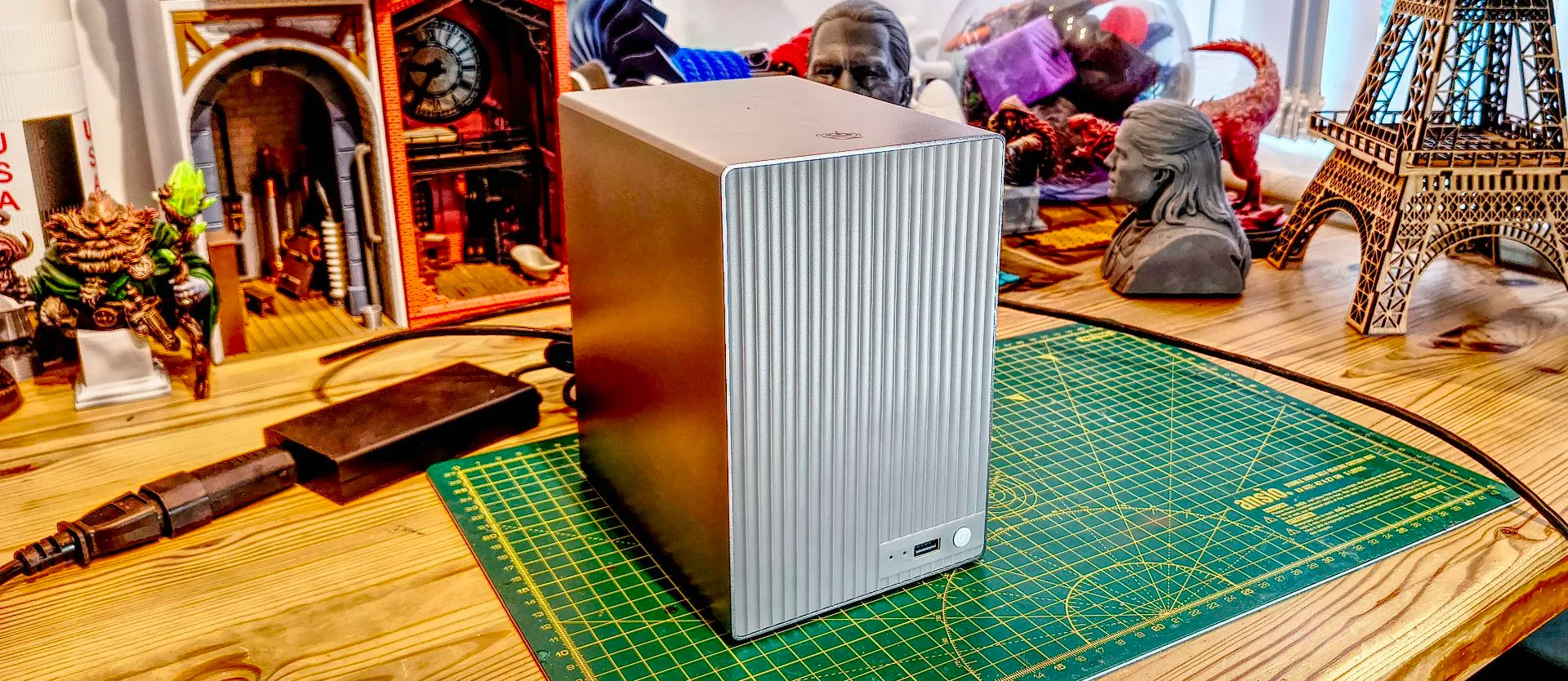
What makes the Beelink ME Pro Creator Edition unique for professionals?
The Beelink ME Pro Creator Edition differentiates itself by offering desktop-class processing power within a remarkably small footprint. Unlike traditional Network Attached Storage (NAS) devices that often rely on low-power, entry-level processors, this model utilizes the Intel Core i5-13500H mobile processor. This chip provides 12 cores and 16 threads, supporting a 45W TDP, which allows for much more intensive computational tasks such as media transcoding or managing complex file indexing.
The hardware configuration is specifically tuned for high-bandwidth workflows. The review unit comes equipped with 32GB of DDR4 memory, which is expandable up to 96GB, providing the headroom necessary for memory-intensive applications. Storage versatility is a core strength; the device features four bays capable of housing either 2.5-inch or 3.5-inch drives (HDD or SSD) and includes four M.2 slots. Specifically, it offers two M.2 NVMe Gen4 x4 slots and two M.2 NVMe Gen3 x2 slots, ensuring that high-speed caching or primary storage can keep pace with the processor's capabilities.
Targeted performance for creative workloads
For video editors and photographers, the combination of a high-performance CPU and rapid M.2 storage is critical. The inclusion of a 10GbE LAN port ensures that the network bottleneck is minimized, allowing for fast data transfers across a local network. This makes the ME Pro feel less like a simple storage appliance and more like a dedicated high-speed server for professional workstations.
How is the design and thermal management handled?
Beelink has opted for a compact, all-metal unibody design that measures just 165 x 121 x 185mm and weighs 2.4kg without drives. This footprint is approximately 50 per cent smaller in volume than many conventional NAS designs, making it a viable option for desktop placement. To manage the heat generated by the 45W TDP processor and the high-speed NVMe drives, the device employs a specialized cooling strategy.
Instead of a traditional array of multiple case fans, the ME Pro uses an internal blower mounted on the motherboard module. This blower pulls cool air into the chassis and pushes it out, working in tandem with the milled aluminium construction which acts as a heat sink. Furthermore, silicone mounts are positioned around each drive and between the motherboard tray and the case to mitigate vibration and acoustic noise, a vital consideration for users working in quiet studio environments.
The 'Drawer' concept for easy maintenance
One of the most innovative aspects of the design is the drawer-style mechanism. The motherboard module itself is designed to slide out, similar to how the drives are accessed. This concept is intended to simplify hardware upgrades and maintenance, potentially allowing users to swap out processor modules more easily than in standard NAS architectures. Beelink has even suggested that future iterations might support different platforms, such as AMD or ARM boards, within the same chassis.
What are the strengths and weaknesses of the hardware build?
The build quality of the ME Pro is high, characterized by excellent enclosure tolerances and a premium feel. However, the pursuit of a compact form factor has necessitated some practical compromises in the assembly process. While the aluminium unibody is robust, certain user-facing elements could be improved to enhance the experience of upgrading the device.
A primary criticism involves the drive installation process. Unlike many modern NAS units that prioritize tool-less designs, the ME Pro requires multiple screws for both 2.5-inch and 3.5-inch drives. Each drive requires four screws for installation and an additional two to secure the tray from the rear. Additionally, the motherboard tray is held in place by four small screws that can be easily lost during maintenance. There is also a minor ergonomic issue with the rear air filter; ten small magnets used to hold the steel filter are placed very close to the tray screw locations, which can cause the magnets to interfere with the screwdriver during assembly.
Storage capacity and RAID options
Despite the assembly quirks, the storage potential is vast. The unit supports a maximum capacity of 120TB across the four HDD bays (using 30TB drives) and an additional 16TB via the M.2 slots. For data protection, the device supports several RAID configurations, including Basic, Linear, RAID 0, 1, 5, 6, and 10. This flexibility allows users to balance capacity, performance, and redundancy according to their specific professional needs.
How does the FygoOS software impact the user experience?
The Beelink ME Pro runs on FygoOS, an operating system that shifts the device's identity from a mere storage appliance to a versatile computing platform. FygoOS is a well-featured system that provides many of the advanced functionalities typically reserved for much more expensive enterprise-grade NAS solutions. This software layer is essential for making the high-end hardware accessible and useful for various automated tasks and file management workflows.
The operating system supports a wide range of file systems, including BTRFS, EXT4, and ZFS for internal storage, while offering compatibility with various external formats like NTFS, FAT32, HFS+, and ExFAT. This broad compatibility ensures that moving data between the ME Pro and other devices (such as Mac or Windows workstations) is seamless. The software evolution seen in Beelink's recent products suggests that FygoOS is maturing into a robust environment capable of handling the heavy lifting required by the Creator Edition hardware.
What is the pricing and availability for the ME Pro series?
The Beelink ME Pro range is launching primarily through Kickstarter, which introduces a level of uncertainty regarding exact delivery dates. Beelink is offering a "Super Early Bird" discount of 30 per cent for early backers. The pricing structure is tiered across several models, ranging from entry-level Intel J5005 units to high-end AMD Ryzen AI models.
The flagship Core i5 13500H model, which defines the Creator Edition, is priced at $819 during the Super Early Bird period, rising to a list price of $1,169. For those looking for even higher performance, the AMD Ryzen AI 9 HX 470 model is available for $1,379 (Super Early Bird) or $1,969 (List price). For budget-conscious users, the series starts as low as $369 for the J5005 model. It is important to note that these prices do not include the cost of hard drives or SSDs.
| Model | CPU Type | Super Early Bird Price | List Price |
|---|---|---|---|
| J5005 | Intel J5005 | $369 | $529 |
| N95 | Intel N95 | $489 | $699 |
| N150 | Intel N150 | $539 | $769 |
| Core 3 304 | Intel Core 3 304 | $769 | $1,099 |
| Core i5 13500H | Intel Core i5 13500H | $819 | $1,169 |
| Ryzen AI 7 H 350 | AMD Ryzen AI 7 H 350 | $1,049 | $1,499 |
| Ryzen AI 9 HX 470 | AMD Ryzen AI 9 HX 470 | $1,379 | $1,969 |
FAQ: Beelink ME Pro Creator Edition
Is the Beelink ME Pro Creator Edition suitable for video editing?
Yes, the device is specifically designed for this purpose. The Intel Core i5-13500H processor, combined with up to 96GB of RAM and 10GbE networking, provides the computational power and data throughput required for high-resolution video editing and large file transfers.
What is the difference between the ME Pro and standard NAS devices?
The primary difference lies in the processing power. While standard NAS devices often use low-power CPUs for simple file storage, the ME Pro uses high-performance mobile processors (Intel Core or AMD Ryzen) to enable intensive tasks like transcoding and AI processing.
Can I upgrade the RAM in the ME Pro?
Yes, the review unit comes with 32GB of DDR4, but the system is expandable. Users can potentially upgrade the memory to a total of 96GB by using dual 48GB modules, which is beneficial for professional workloads.
How does the cooling system work in such a small case?
The device uses an internal blower on the motherboard module rather than multiple small fans. This single blower pulls air in and pushes it out, while the milled aluminium unibody helps dissipate heat through radiation.
Is this product available for immediate purchase?
No, the ME Pro range is launching via Kickstarter. This means that while early backers can receive significant discounts, the product is not yet available through traditional retail channels, and delivery dates may vary.
Key takeaways
- The Creator Edition features a powerful Intel Core i5-13500H CPU with 12 cores and 16 threads.
- It offers a compact, all-metal unibody design that is 50% smaller than many conventional NAS units.
- The device supports high-speed 10GbE networking and extensive M.2 NVMe storage options.
- Pricing for the flagship model starts at $819 via Kickstarter Super Early Bird discounts.
Final thoughts on the Beelink ME Pro series
The Beelink ME Pro Creator Edition represents a significant shift in the NAS market by bringing high-performance computing to a compact, professional-grade storage enclosure. By combining a powerful Intel Core i5 processor with the flexible FygoOS, Beelink has created a device that functions more like a high-speed server than a simple drive array. While the Kickstarter launch requires patience and the manual drive installation is a minor inconvenience, the sheer value and hardware capability make it a compelling option for creative professionals seeking to centralize their high-speed workflows.