
Why are Boston Dynamics employees protesting the ICE deal?
More than 300 employees at Boston Dynamics have formally petitioned the company's leadership to halt the sale of its quadruped robots to U.S. Immigration and Customs Enforcement (ICE). The petition, which represents a significant portion of the company's approximately 1,400-person workforce, was shared with major media outlets including The Boston Globe and WBUR. Notably, about half of the signatories chose to remain anonymous due to the sensitive nature of the internal dissent.
The protesters expressed deep moral distress, stating that many staff members have faced disbelief and horror from friends and family regarding the partnership. The petition highlights a fundamental tension between the company's innovative mission and its perceived complicity in government actions. Signatories argued that the reputational risk to Boston Dynamics is too substantial to justify continuing the agreement.
The connection to Hyundai and labor concerns
The protest takes on an additional layer of complexity due to the company's ownership structure. Boston Dynamics was acquired by the Hyundai Motor Group in June 2021. Employees pointed to a specific incident on September 4, 2025, involving a workplace raid by ICE and Homeland Security Investigations (HSI) at the Hyundai Motor Group Metaplant America facility in Georgia. During that operation, 475 workers, many of whom were South Korean nationals, were detained. The petition explicitly noted the irony and pain of working for a company whose technology might be used by an agency that has targeted workers from the parent company's own ecosystem.
What are the technical specifications of the Cerberus robot?
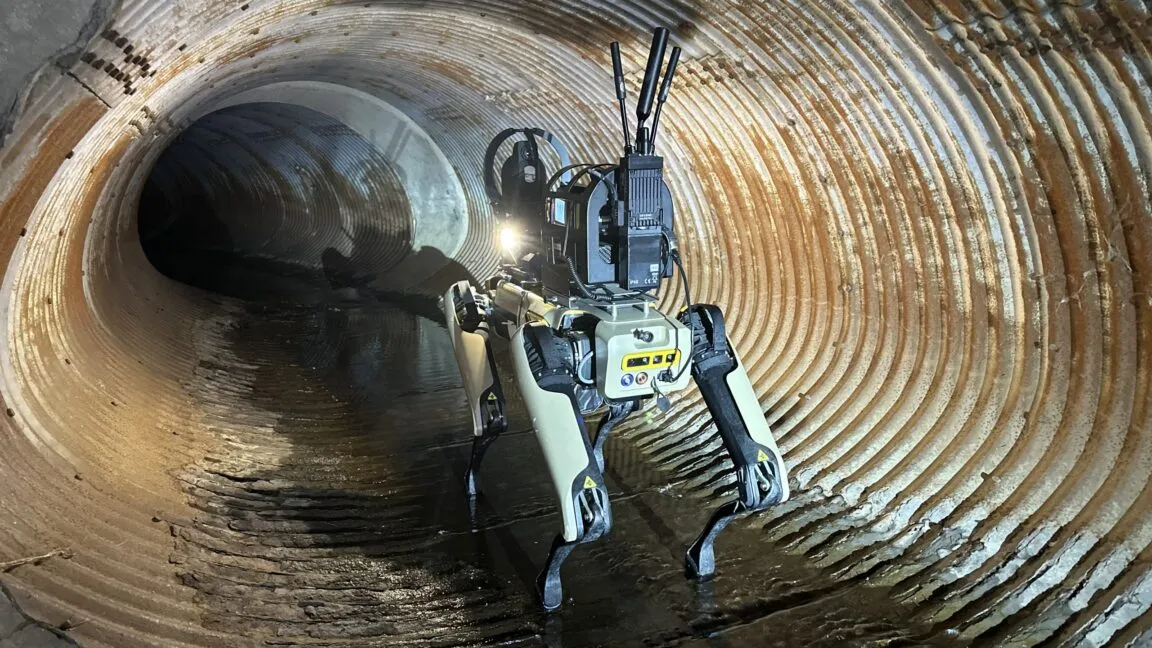
The contract involves the delivery of four modified robots, marketed under the name Cerberus, which are developed by the Connecticut-based company Radeco. While based on the standard Boston Dynamics Spot platform, the Cerberus units are upgraded with specialized equipment designed for hazardous environments and remote observation. The Department of Homeland Security (DHS) has allocated $1.3 million for these specific units to support missions involving counter-illicit cross-border tunnel operations and the dismantling of smuggling networks.
According to the contract details, the Cerberus platform is equipped with several advanced sensory and mechanical tools:
- Environmental Sensing: An integrated oxygen sensor to ensure air quality in confined spaces like tunnels, alongside sensors for radiation, toxic gas, and explosives.
- Visual Capabilities: A camera system featuring 30-times zoom, 360-degree coverage, and infrared thermal imaging for night or low-visibility operations.
- Mechanical Utility: An optional robotic arm that allows the unit to manipulate objects, open doors, and provide varied camera perspectives.
- Autonomy: The ability to navigate complex industrial settings and execute repeatable missions with minimal human intervention.
How does Boston Dynamics respond to weaponization concerns?
Boston Dynamics leadership has maintained that the robots are intended to serve humanity and improve safety rather than act as weapons. In a communication to staff, former interim CEO Amanda McMaster stated that the decision aligns with the company's purpose of ethically advancing intelligent machines. The company emphasizes that the robots are tools designed to keep personnel out of harm's way by performing dangerous inspections in disaster zones or criminal environments.
To address fears of misuse, the company points to strict contractual terms and conditions. These terms explicitly prohibit the intentional use of the product to harm or intimidate any person or animal, or to enable the use of any weapon. A spokesperson for the company clarified that they have a robust enforcement mechanism for violators.
Enforcement of ethical usage terms
If a customer is found to be violating the terms of service—such as using a Spot robot for unauthorized combat or intimidation—Boston Dynamics has pledged to take immediate punitive action. These measures include:
- Voiding the existing product warranty.
- Refusing all future software updates.
- Terminating the user's license.
- Pursuing all available legal remedies.
- Permanent blacklisting from future sales.
The company noted that, to date, there have been no recorded instances of customers violating these terms while working with public safety agencies or the DHS.
What is the role of Homeland Security Investigations (HSI)?
A central point of contention is the specific role of the Homeland Security Investigations (HSI) unit within the broader ICE framework. While Boston Dynamics asserts that the robots will primarily support HSI's efforts to combat transnational criminal organizations and human trafficking, critics point to the unit's history in immigration enforcement. The distinction between fighting cartels and conducting deportations has become a focal point for the employee backlash.
Historical data and policy shifts have complicated the perception of HSI's mission. During the first Trump administration (2018–2021), the Brennan Center for Justice documented HSI's involvement in workplace raids and the deportation of undocumented workers. Although these specific operations were halted by Secretary Alejandro Mayorkas during the Biden administration, the mission profile shifted again following the start of President Trump's second term in January 2025. An executive order redefined the unit's primary mission, leading to the diversion of thousands of agents toward immigration enforcement and deportations, according to the Immigration Policy Tracking Project.
FAQ: Boston Dynamics and the ICE Contract
Why is Radeco involved in this deal?
Radeco is a Connecticut-based company that acts as the intermediary for the contract. They are responsible for modifying the standard Boston Dynamics Spot robots into the specialized Cerberus platform, which includes the military-grade sensors and equipment required by the Department of Homeland Security.
Can the Spot robot be used as a weapon?
Boston Dynamics states that the robots cannot be used as weapons under their terms of sale. The company's policies strictly prohibit the intentional use of the product to harm or intimidate people or animals, and they have pledged to terminate support for any customer who violates these rules.
How many employees signed the protest petition?
More than 300 employees signed the petition calling for the company to cancel the contract. This number represents a significant portion of the total workforce, which consists of approximately 1,400 people. About half of these signatories requested anonymity.
What is the Cerberus robot's primary purpose?
The Cerberus robot is designed for high-risk inspection and observation. Its primary functions include detecting radiation, toxic gas leaks, and explosive threats, as well as monitoring air quality in confined spaces to ensure the safety of human personnel.
How does the Hyundai ownership affect the situation?
Boston Dynamics is owned by the Hyundai Motor Group. The employee protest highlights the tension caused by ICE operations at Hyundai's Metaplant America facility in Georgia, where a large-scale raid in September 2025 resulted in the detention of hundreds of workers.
Key takeaways
- Over 300 Boston Dynamics staff signed a petition protesting the $1.3 million ICE contract.
- The contract involves Radeco-modified 'Cerberus' robots designed for hazardous environment detection.
- Executives insist the robots are safety tools and prohibit their use as weapons.
- The protest is linked to concerns over HSI's role in immigration enforcement and raids.
Conclusion
The conflict at Boston Dynamics underscores the growing ethical challenges facing the robotics industry as advanced technology intersects with sensitive government operations. While the company maintains that its tools are designed to enhance safety and combat transnational crime, the internal backlash reveals a deep divide regarding the potential for dual-use technology. As the company expands its AI and robotics footprint in Massachusetts, the resolution of this tension—between corporate contracts and employee ethical standards—will likely set a precedent for how the sector manages the deployment of autonomous systems in public safety roles.