
Why is operational context vital for enterprise AI scaling?
Operational context serves as the bridge between generalized AI capabilities and the highly specialized requirements of a functioning business. Many organizations are currently transitioning from the experimentation phase—characterized by demos and pilots—to the scaling phase, where leadership requires tangible proof of ROI and bottom-line impact. However, a significant gap exists because most AI models apply broad, universal principles to scenarios that require specific local knowledge.
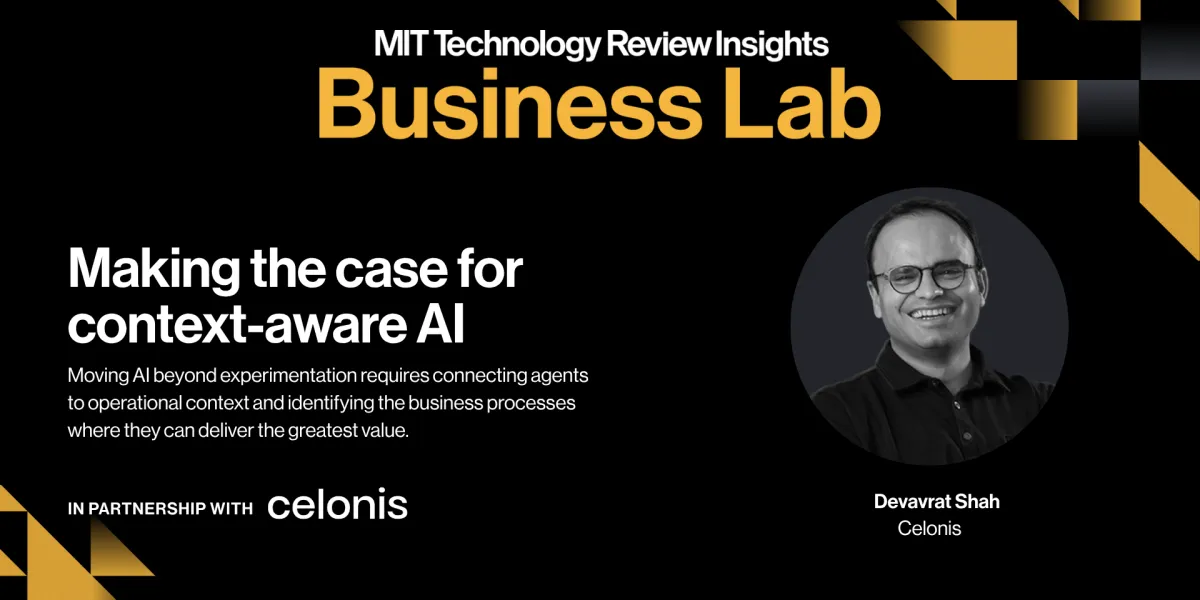
Devavrat Shah, a professor at MIT and chief scientist of enterprise AI at Celonis, suggests that the most significant transformation in the industry will come from "decision intelligence." He explains that business decisions are typically the result of a sequence of tasks or roles. While AI can provide "agentic power" to support or automate these individual tasks, it cannot do so effectively in a vacuum. To be useful, an AI agent must understand the role it is playing within the larger organizational structure and the specific business conditions surrounding that task.
The transition from tasks to decisions
In a typical enterprise, decisions are categorized as either strategic (episodic) or operational (high-frequency). Both types rely on established processes: a sequence of "do this, then that" steps. AI's role is to augment or automate the specific tasks within these processes. Without context, the AI does not know which step it is performing or how that step influences the final decision, making it a mere calculator rather than an intelligent participant in the workflow.
What are the commercial risks of deploying context-less AI?
Deploying AI agents without an understanding of business constraints introduces two primary categories of risk: excessive resource consumption and catastrophic decision errors. When a frontier model is tasked with a specialized business problem without context, it may attempt to compensate for its ignorance by asking endless questions or processing massive amounts of data to "figure out" the situation. This leads to significant inefficiencies in computing costs.
More critically, the lack of context can lead to decisions that violate essential business guardrails. Shah distinguishes between low-stakes errors and high-stakes failures. A low-stakes error might be an AI recommending a restaurant that a user doesn't enjoy. In a corporate environment, however, a high-stakes error could involve an incorrect financial forecast that leads to severe organizational consequences. Without a contextual layer, the AI is unaware of the "guardrails" that prevent such expensive mistakes.
How can organizations implement a contextual layer?
The integration of a contextual layer involves connecting AI directly to the existing data ecosystems and workflows that define an enterprise's operations. Rather than treating AI as an external tool, companies should aim to embed it within their processes so that it understands the "digital twin" of their organization. This allows agents to operate within defined boundaries and produce recommendations that are actually actionable and safe.
Shah recommends a pragmatic, incremental approach to implementation rather than attempting a total overhaul. Organizations should follow these steps:
- Identify a specific decision: Rather than trying to automate everything, pick one critical business decision point.
- Isolate the difficult steps: Determine which parts of that decision-making process are currently the most complex or manual.
- Test for value: Deploy AI to assist with those specific steps and measure the impact on speed and accuracy.
- Scale based on evidence: Use the measured gains in value to justify expanding the application to other areas.
How will context-aware AI reshape the workforce?
The shift toward context-aware AI and decision intelligence will fundamentally alter how employees spend their time. By automating repetitive, manual, and high-frequency operational tasks, AI can free human workers to focus on higher-order strategic decisions. This transition moves the human role from performing the task to overseeing the intelligence that performs the task.
However, this evolution requires more than just software deployment; it necessitates a significant investment in workforce education. Employees must be trained not just to use AI, but to interpret its outputs and understand the implications of its recommendations. The goal is to prevent a scenario where employees blindly hand over decision-making to agents, and instead creates a collaborative environment where humans provide the ultimate oversight and strategic direction.
Future applications of decision intelligence
As these technologies mature, the scope of application is expected to expand from routine operational tasks to enterprise-wide planning. Key areas identified for potential transformation include:
- Finance: More accurate forecasting and automated compliance checks.
- Workforce Management: Optimized scheduling and resource allocation.
- Marketing and Sales: Highly personalized, contextually relevant customer engagement.
- Resource Planning: Reducing the time required for complex logistical coordination.
FAQ: Context-aware AI and Decision Intelligence
What is the difference between AI and decision intelligence?
AI refers to the underlying models and agents capable of performing tasks or generating content. Decision intelligence is the application of that AI within a specific business context, ensuring the technology understands the processes, constraints, and goals required to support effective organizational decision-making.
Why do AI agents consume so much compute without context?
Without specific operational data, a generalized AI model must work harder to resolve ambiguities. It may attempt to simulate or query vast amounts of information to reach a conclusion that a context-aware system would have known instantly through its connection to enterprise workflows.
Can AI make decisions entirely on its own?
While AI can be used to automate certain tasks, the current recommendation for enterprises is to use AI to augment or support decision-making. This allows for human oversight, ensuring that the AI operates within established guardrails and that strategic accountability remains with human leaders.
What are the first steps to adopting context-aware AI?
Organizations should start small by identifying a single, high-value business decision. They should then pinpoint the most difficult steps within that decision process and test whether AI can improve them, measuring the results in terms of speed and value before scaling further.
How does context prevent business errors?
Context provides the "guardrails" for AI. By understanding the specific rules, constraints, and historical data of a company, a context-aware AI can avoid suggesting actions that are technically possible but operationally or financially disastrous for that specific organization.
Key takeaways
- Context-aware AI integrates specific business workflows to move beyond generalized experimentation into scalable enterprise utility.
- Decision intelligence uses AI to augment or automate specific tasks within a larger, structured decision-making process.
- Lack of operational context creates risks of high computing costs and expensive, high-stakes business errors.
- Successful implementation requires starting with specific decisions and measuring gains in speed and value before scaling.
- Workforce education is essential so employees can interpret AI outputs rather than delegating decisions blindly.
The future of enterprise intelligence
The transition from experimental AI to mainstream enterprise utility hinges on the ability to provide machines with operational reality. As organizations move toward decision intelligence, the focus shifts from what an AI can do in isolation to how it can function as a contextualized participant in complex workflows. While the challenges of computing costs and workforce adaptation are real, the potential for increased strategic capacity and operational efficiency is vast. By embedding AI within the actual fabric of business processes, companies can finally unlock the true value of autonomous and augmented intelligence.




