
What does the new Elizabeth Holmes documentary reveal?
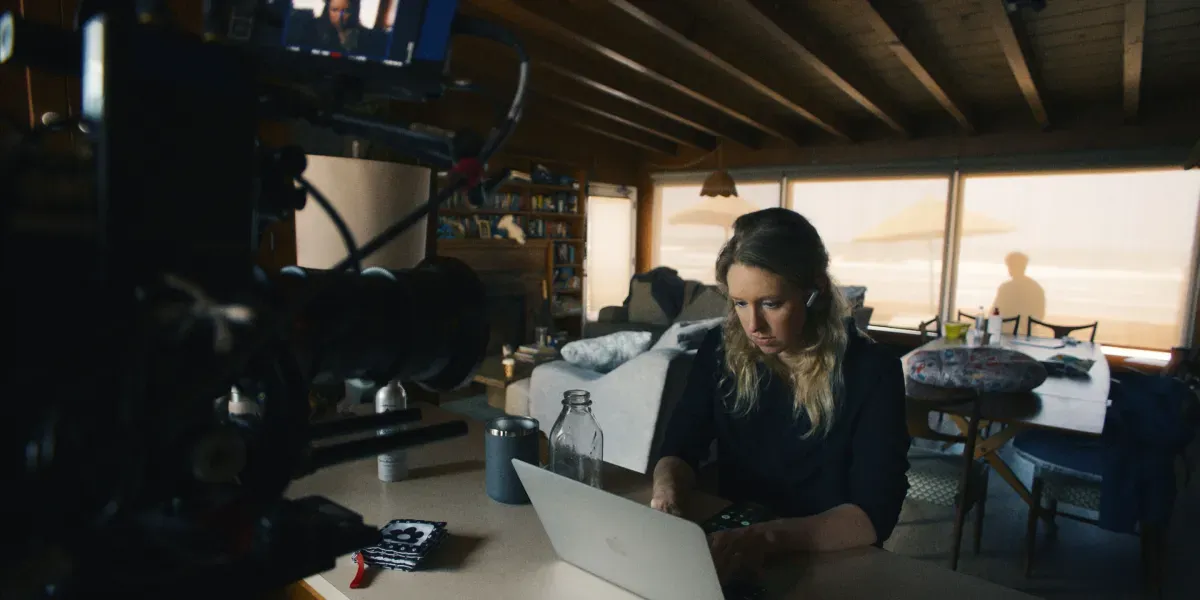
The documentary You Can See Everything offers an intimate, close-up portrayal of Elizabeth Holmes and her attempt to reshape her public narrative. Unlike previous media coverage, such as the book Bad Blood or the Hulu series The Dropout, this film documents Holmes in a highly personal setting, including her home life with her partner, Billy Evans, and their two young children.
Filmmakers Nathan Fielder and Lance Oppenheim captured footage of Holmes shortly before she began serving her prison sentence in May 2023. The film utilizes extreme close-ups, creating a sense of intense scrutiny as the subjects attempt to navigate their interactions with the camera crew. For Holmes, the project appears to be a calculated effort to present herself as an honest individual possessing an unconventional mind, rather than a convicted fraudster.
However, the documentary also highlights her continued ability to manipulate perception. Even viewers who are well-versed in the facts of the Theranos case report feeling unsettled by her presence. The film captures how she can plant seeds of doubt in others, making even the most informed observers question the simplicity of her deception.
The power of narrative manipulation
The documentary serves as a psychological study of how an effective manipulator can leverage intimacy to bypass skepticism. By inviting cameras into her private life, Holmes attempts to humanize herself, using her role as a mother and her personal struggles to create empathy. This tactic makes it difficult for the audience to maintain a purely objective stance, illustrating why even seasoned journalists were previously deceived by her charisma.
How did the Theranos scandal unfold?
The Theranos saga represents one of the most significant technological and financial failures in recent biotech history. Founded by Elizabeth Holmes in 2003 after she dropped out of Stanford University at age 19, the company claimed to have revolutionized diagnostics by performing over 100 tests using only a few drops of blood.
At its peak in 2014, Theranos was valued at $9 billion, and Holmes was recognized by Forbes as the youngest self-made female billionaire, with a personal net worth of $4.5 billion. The downfall began in 2015 following an investigation by the Wall Street Journal, which exposed several critical issues:
- Former employees alleged that the company's proprietary testing technology did not function as claimed.
- The company reportedly used third-party machines to analyze blood samples instead of its own devices.
- Testing procedures were insufficient, leading to inaccurate results for patients.
By 2016, Forbes had revised Holmes's net worth to zero. Legal consequences followed, with Holmes and former president Ramesh Balwani being charged with "massive fraud" in 2018. In 2022, Holmes was sentenced to more than 11 years in prison for defrauding investors.
Why is verifying scientific claims so difficult?
The Theranos case highlights a fundamental vulnerability in the biotech sector: the difficulty of observing and verifying scientific breakthroughs before they reach the market. One of the primary red flags in the Theranos case was the company's refusal to publish peer-reviewed data, instead shielding its methods under the guise of "trade secrets."
In traditional science, peer review acts as a safeguard. This process involves independent experts evaluating research to ensure rigor, identify errors, and validate conclusions. However, the system is not infallible. Even within established frameworks, scientific integrity can be compromised by:
- Researchers exaggerating the significance of their findings.
- The manipulation of data to support a specific hypothesis.
- The failure of peer reviewers to detect sophisticated deceptions.
According to data on research integrity, the scale of error is significant; for instance, 10,000 research papers were retracted in 2023. This underscores the reality that even published science requires constant interrogation.
How is the landscape of scientific publishing changing?
The traditional model of peer-reviewed journal publication is being supplemented, and sometimes bypassed, by newer methods of information dissemination. While peer review remains the gold standard for rigor, the speed of modern science has led to a shift in how data is shared.
Many researchers now utilize preprint servers such as arXiv, medRxiv, and bioRxiv. These platforms allow scientists to share findings immediately, bypassing the lengthy peer-review process used by established journals. While this accelerates the spread of knowledge, it also means that much of the information circulating in the scientific community has not yet been vetted by independent experts.
Beyond academic servers, scientific claims are increasingly disseminated through:
- Company press releases and marketing materials.
- Social media posts and digital platforms.
- Conference presentations and live interviews.
This shift places a higher burden of responsibility on journalists and investors to conduct their own "due diligence" or informal peer review. As seen with the Theranos case, relying on an appealing narrative or a charismatic spokesperson can lead to catastrophic failures in judgment.
FAQ: Elizabeth Holmes and the Theranos Case
What was the main fraud committed by Theranos?
Theranos claimed to have developed a technology capable of running hundreds of diagnostic tests using only a small amount of blood. In reality, the technology was unreliable, and the company used standard third-party machines to process many of the samples while misleading investors and patients about their proprietary device's capabilities.
How long was Elizabeth Holmes sentenced to?
In 2022, Elizabeth Holmes was sentenced to a little over 11 years in prison. The sentence was the result of her conviction for defrauding investors regarding the capabilities and success of the Theranos diagnostic technology.
Why did Theranos avoid peer-reviewed publications?
Theranos categorized much of its research and technological methodology as "trade secrets." By avoiding the peer-review process, the company was able to prevent independent scientists from scrutinizing their data and validating their claims, which contributed to the eventual exposure of their fraud.
What role did the Wall Street Journal play in the scandal?
The Wall Street Journal played a pivotal role in exposing the company in 2015. Through investigative reporting, the publication brought to light whistleblower allegations that the company's tests were inaccurate and that they were secretly using conventional machines to perform many of their diagnostic tests.
What are preprint servers in science?
Preprint servers, such as bioRxiv and medRxiv, are online platforms where scientists share their research papers before they undergo formal peer review. This allows for faster communication of findings within the scientific community but means the data has not yet been officially validated by independent experts.
Key takeaways
- The Elizabeth Holmes documentary explores her attempt to reframe her reputation following her fraud conviction.
- Theranos reached a $9 billion valuation based on unproven claims regarding finger-prick blood testing.
- A lack of peer-reviewed data was a major warning sign during the Theranos investigation.
- The scientific community saw 10,000 research paper retractions in 2023, highlighting ongoing integrity challenges.
The challenge of scientific transparency
The saga of Elizabeth Holmes and Theranos serves as a permanent warning for the biotechnology industry and the media. While the majority of scientific endeavors are driven by genuine discovery, the ability of a single individual to weaponize a compelling narrative against the rigors of scientific scrutiny is a documented reality. As the methods of scientific communication continue to evolve through preprints and digital media, the necessity for rigorous, independent verification remains more critical than ever. Maintaining skepticism and demanding transparency is the only way to protect the integrity of scientific progress.




