
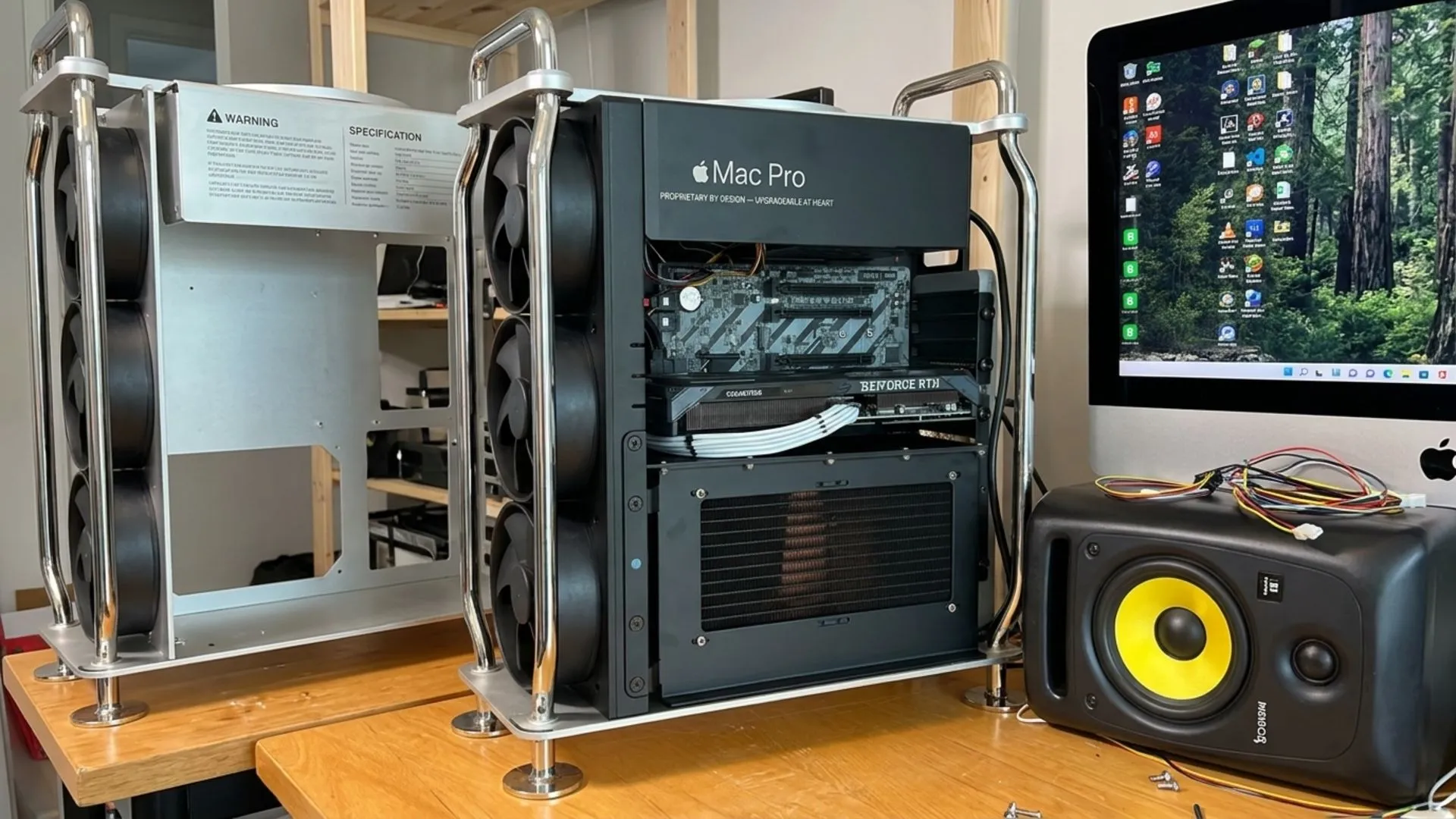
What is the purpose of the Mac Pro conversion kit?
The primary goal of the proposed conversion kit is to enable owners of the 2019 Mac Pro 7,1—frequently nicknamed the 'Cheesegrater' due to its perforated aluminium exterior—to reuse their existing chassis for a standard desktop PC build. Instead of being locked into Apple's proprietary architecture, which limits upgradeability, users could install conventional hardware inside the high-quality Apple enclosure.
The kit acts as a structural and electronic bridge. It is designed to replace the internal Apple components with a framework that accommodates standard PC parts. This allows the aesthetic and physical presence of the Mac Pro to remain intact while providing the functional flexibility of an open PC platform. By doing so, the kit seeks to extend the lifecycle of the 2019 Mac Pro chassis for users who no longer require macOS or who find Apple's hardware ecosystem too restrictive.
Bridging the gap between Apple and PC standards
The conversion essentially transforms a closed ecosystem into an open one. By providing mounting plates and custom circuit boards, the kit allows the integration of ATX-standard components into a non-standard chassis. This is a significant technical challenge, as Apple's internal layout does not follow the industry-standard mounting points used by most motherboard and power supply manufacturers.
What hardware components are supported by the kit?
The conversion kit is engineered to support a wide range of standard PC hardware, provided the components meet specific dimensional requirements. To ensure compatibility, the kit accommodates ATX motherboards and standard power supplies, which are the industry benchmarks for desktop computing.
Detailed specifications for the supported hardware include:
- Graphics Cards: Supports GPUs up to 308 mm in length and 140 mm in height.
- Cooling Solutions: Compatible with air coolers up to 140 mm tall or liquid cooling systems utilizing radiators up to 240 mm in length.
- Storage: Provides space for two SATA drives, supporting both 2.5-inch and 3.5-inch form factors.
Beyond the core processing units, the kit includes various mounting and connection accessories. These include a motherboard and power supply mounting plate, two drive sleds, two drive cables, and custom circuit boards. A dedicated bracket is also provided to manage the motherboard's rear connections and expansion slots, ensuring that the transition from Apple's proprietary layout to a standard PC layout is as seamless as possible.
How does the kit retain the original Mac Pro features?
A key sellingage of the conversion kit is its ability to preserve the functional and aesthetic elements of the original Mac Pro. Rather than treating the Apple chassis as a mere shell, the kit uses custom electronic interfaces to keep the original user controls and cooling systems operational.
The kit is designed to maintain the following original features:
- Cooling: The three original front fans can remain in service through the use of three custom adapter circuit boards and specialized wiring.
- User Interface: A dedicated interface connects the original power button and the indicator light to the new PC hardware.
- Connectivity: The two original USB-C ports, which support USB 3.1 Gen 1, remain functional via a specialized electronic component.
This integration ensures that the user experience remains familiar. The power button and status lights will respond to the new PC components, and the high-speed USB-C ports will continue to provide connectivity, preventing the chassis from feeling like a hollowed-out shell.
What are the costs and requirements for a conversion?
While the conversion kit itself is expected to cost approximately $500, this figure only covers the modification hardware. Users must budget for a significant amount of additional equipment to complete the build, as the kit does not include the actual computing components.
The total cost of a converted Mac Pro will depend on the quality of the following separately purchased parts:
- Motherboard and Processor
- Graphics Card (GPU)
- Memory (RAM)
- Power Supply Unit (PSU)
- Storage Drives (SSD/HDD)
- Cooling System (Air or Liquid)
Technical expertise required for installation
Because this process involves stripping a complex machine and reconfiguring its electronic and structural layout, it is not a plug-and-play solution. The installation requires removing all original internal components and manually fitting the new parts and wiring. Consequently, the kit is intended for experienced PC builders. While a fitting guide is included to assist with the process, the complexity of connecting custom circuit boards and managing cable routing means that novice users may struggle to complete the conversion successfully.
One advantage of this method is that the conversion is theoretically reversible. Because the kit is designed to fit within the existing chassis without permanent destruction, owners could, in theory, reinstall the original Apple hardware at a later date, provided they have kept the original components safe.
What is the current status of the Kickstarter campaign?
Despite the technical ambition of the project, the crowdfunding campaign has seen very little traction. As of the latest report, the Kickstarter project has raised only $7 from a single backer. This is a stark contrast to the stated funding goal of $10,686 required to bring the project to fruition.
With 28 days remaining in the campaign, the project faces a significant uphill battle to reach its target. The lack of momentum suggests that either the market interest in repurposing the 2019 Mac Pro is lower than anticipated, or the potential costs and technical hurdles are deterring potential backers. It is important to note that crowdfunding projects carry inherent risks, including the possibility of delivery delays or the project failing to deliver the promised product entirely.
Frequently asked questions
Will the conversion kit work with any Mac Pro?
The kit is specifically designed for the 2019 Mac Pro 7,1, often called the 'Cheesegrater' model. It is intended to adapt that specific aluminium enclosure to house standard PC parts. It is not designed for other Mac Pro generations or different Apple chassis.
Is the $500 price tag the total cost of the build?
No, the $500 estimate is only for the conversion kit itself. To have a working computer, users must separately purchase all the essential PC components, including the motherboard, CPU, RAM, GPU, power supply, and storage, which will significantly increase the final price.
Can I use liquid cooling with this kit?
Yes, the kit supports liquid cooling configurations. Specifically, it can accommodate radiators that are up to 240 mm in length. However, users must ensure their chosen cooling system fits within the physical constraints of the Mac Pro enclosure.
Is it possible to undo the conversion?
Yes, the design allows for the conversion to be reversed. Since the kit is designed to fit within the existing chassis rather than permanently modifying it, owners can reinstall the original Apple hardware if they choose to do so in the future.
Do I need to be an expert to install the kit?
Yes, the installation process is complex and requires removing original internals and connecting custom wiring and circuit boards. The project creator recommends that the kit be used by experienced PC builders who are comfortable with advanced hardware assembly.
Key takeaways
- The kit allows 2019 Mac Pro owners to install standard ATX PC components.
- The conversion kit is expected to cost approximately $500 per unit.
- The kit supports GPUs up to 308 mm long and 140 mm tall.
- Original front fans and USB-C ports can be retained via custom adapters.
- The Kickstarter campaign has currently raised only $7 of its $10,686 goal.
Conclusion
The proposed Mac Pro conversion kit offers a unique solution for enthusiasts looking to breathe new life into the 2019 'Cheesegrater' enclosure. By bridging the gap between Apple's proprietary design and the flexibility of the PC ecosystem, it provides a path toward improved upgradeability and hardware freedom. However, the high cost of additional components, the requirement for advanced technical expertise, and the current lack of crowdfunding momentum present significant challenges. For now, the project remains a niche concept that highlights the tension between closed hardware ecosystems and the desire for modular, user-driven computing.




