
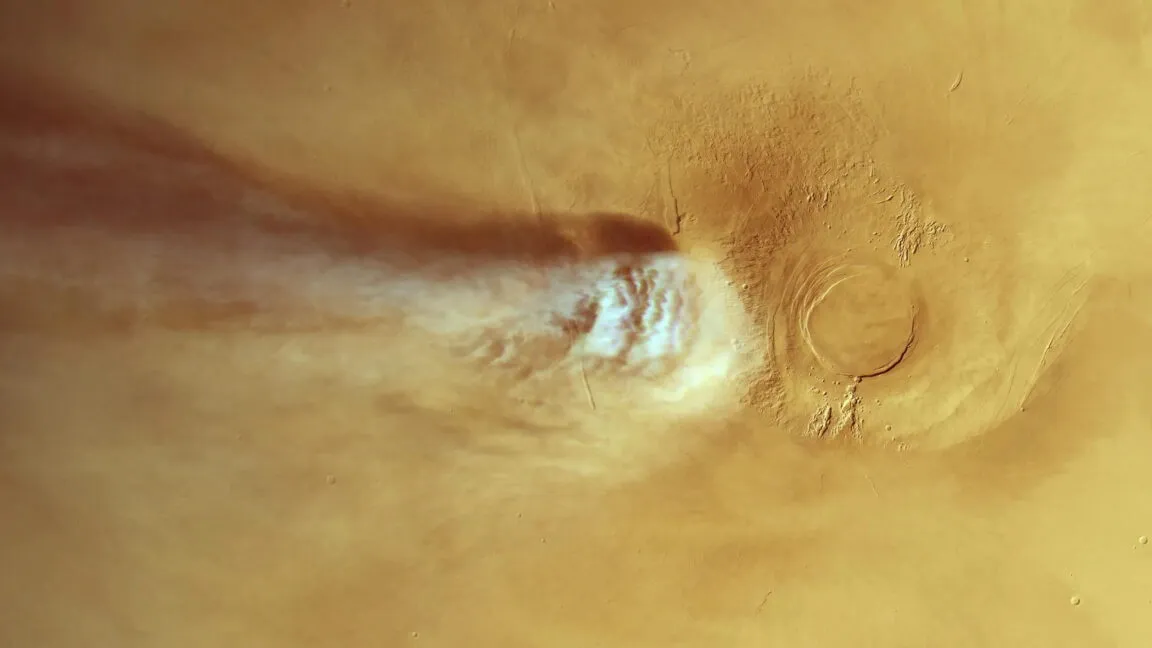
What is the Arsia Mons Elongated Cloud?
The Arsia Mons Elongated Cloud, commonly known as the AMEC, is a transient atmospheric phenomenon on Mars that appears during the planet's spring and summer seasons. This cloud formation begins near the Arsia Mons volcano and expands into a thin, wispy strand that can reach lengths exceeding 1,000 miles. To put this scale in perspective, the cloud's length is comparable to the distance between New York and Kansas City on Earth.
First recorded by a Martian probe in 2018, the AMEC has remained a scientific mystery for nearly a decade. Unlike standard weather patterns, the cloud follows a highly specific and repetitive cycle: it emerges in the morning, elongates across the horizon, and then vanishes. Because of its unique shape and predictable seasonal appearance, it has become a focal point for researchers attempting to understand the complexities of the Martian atmosphere.
How does homogeneous nucleation explain the cloud's formation?
New research suggests that the AMEC forms through homogeneous nucleation, a process where water vapor transitions directly into ice crystals without the presence of nuclei like dust or salt. On Earth, cloud formation is typically a heterogeneous process; water vapor requires tiny particles, such as sea salt or mineral dust, to serve as a foundation for droplets or ice to grow. Without these particles, clouds generally cannot form in the terrestrial atmosphere.
In the case of the AMEC, the modeling indicates that the Martian environment provides the specific conditions necessary for this "exotic" physics to occur. According to Jorge Hernández-Bernal, a planetary scientist at Paris’ Sorbonne Université and the study's lead author, this process is treated in textbooks as theoretical and is rarely observed in natural planetary atmospheres. By incorporating this specific type of nucleation into their simulations, researchers were finally able to replicate the exact appearance and behavior of the AMEC.
Comparing Nucleation Processes
To understand why this is significant, one must look at the fundamental difference between how clouds form on Earth versus how they appear to form on Mars near Arsia Mons. On Earth, the atmosphere is filled with aerosols that act as seeds for condensation. On Mars, the AMEC appears to bypass this requirement entirely.
- Heterogeneous Nucleation (Earth): Vapor + Aerosol (dust/salt) = Cloud droplets.
- Homogeneous Nucleation (Mars AMEC): Vapor + Extreme Conditions = Ice crystals.
Hernández-Bernal uses a helpful analogy to describe this distinction: it is similar to seeing droplets of condensation appear spontaneously in the middle of a room rather than forming on a cold windowpane. This spontaneous formation is what makes the AMEC a unique laboratory for studying physics that is otherwise hidden from view.
What role does the Arsia Mons volcano play in this process?
The topography of Mars, specifically the massive Arsia Mons volcano, acts as the mechanical engine for the cloud's creation. Arsia Mons stands approximately 65,000 feet tall, creating a significant obstacle for atmospheric currents. When wind currents strike the volcano, they trigger a powerful upward wave that forces moist air into the high atmosphere within minutes.
This rapid ascent is critical because it facilitates the extreme environmental shifts required for homogeneous nucleation. The process depends on two primary triggers:
- Rapid Temperature Drops: The air must experience a sharp decrease of approximately 30° Celsius within a mere 10-minute window.
- Extreme Humidity: The air must reach levels of relative humidity that are unprecedented in terrestrial observations.
The combination of the volcanic height and the sudden atmospheric movement creates a localized environment where these extreme conditions can be met, allowing the "exotic" physics to take hold.
The Scale of the Atmospheric Mystery
The implications of this discovery extend beyond just understanding a single cloud. The study, published in Nature Geoscience, highlights how little is known about the Martian atmosphere compared to Earth's. Before this modeling, it was not even known that these specific humidity levels existed on Mars. The ability to reproduce the AMEC through simulation is, as Hernández-Bernal notes, a "big success" and a "remarkable" result.
The sheer scale of the humidity involved is staggering. The relative humidity required for this phenomenon is more than 100,000 times greater than any value ever measured on Earth. This extreme requirement explains why such a phenomenon has not been observed in other planetary atmospheres, including Earth or Venus, despite scientists previously assuming similar phenomena could occur there.
Conclusion
The discovery of the mechanism behind the Arsia Mons Elongated Cloud provides a rare glimpse into a physical process that remains largely theoretical on our own planet. By successfully modeling the AMEC, researchers have not only solved a long-standing Martian mystery but have also identified a unique natural laboratory where textbook physics can be observed in action. As our understanding of the Martian atmosphere grows, the AMEC stands as a testament to the unexpected and extreme nature of the Red Planet's weather.
Key Takeaways
- The Arsia Mons Elongated Cloud (AMEC) is a 1,000-mile-long cloud formation on Mars that appears during spring and summer.
- Unlike Earth clouds, the AMEC likely forms through homogeneous nucleation, where vapor turns to ice without dust or salt particles.
- The Arsia Mons volcano triggers the process by forcing moist air upward, causing a 30°C temperature drop in just 10 minutes.
- The humidity levels required for this process are over 100,000 times higher than anything measured on Earth.
Frequently Asked Questions
What is the Arsia Mons Elongated Cloud?
It is a long, wispy cloud on Mars that forms near the Arsia Mons volcano and can stretch over 1,000 miles before dissipating.
How does the AMEC form differently than clouds on Earth?
Earth clouds usually need particles like dust or salt to form (heterogeneous nucleation), whereas the AMEC forms through homogeneous nucleation, where vapor turns directly into ice.
Why is the Arsia Mons volcano important?
The 65,000-foot volcano creates wind waves that launch moist air into the atmosphere, causing the rapid temperature and humidity changes needed for the cloud to form.




