
The viral impact of the GTC Berlin demonstration
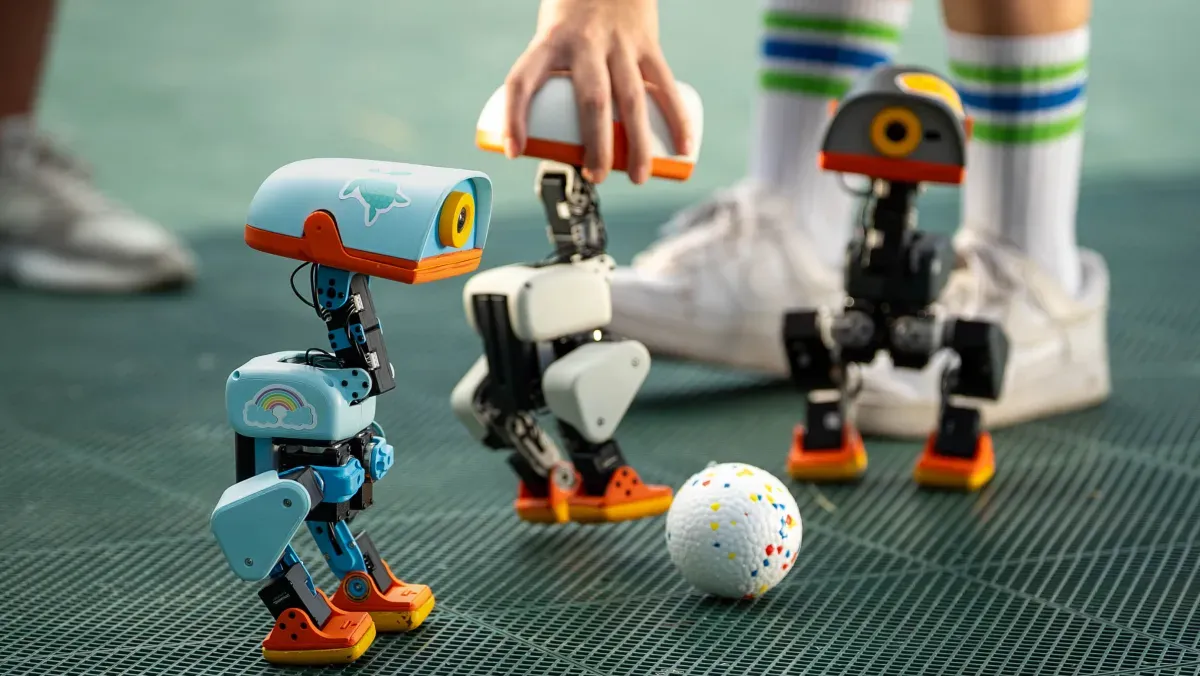
Preorders for the Microduck robots surpassed 20,000 units within just one day of their public debut. This massive spike in consumer interest followed a keynote presentation at Nvidia’s GTC Berlin conference, where CEO Jensen Huang demonstrated the devices' capabilities. The video of the demonstration went viral, showcasing the robots' ability to waddle, sit, and perform summersaults upon receiving voice commands.
The robots are characterized by their expressive, albeit simple, movements and sounds, often described as making small, R2-D2-like noises. Beyond simple movement, the Microducks can mimic biological behaviors, such as falling down to "nap." According to Clem Delangue, CEO of Hugging Face, the viral nature of the video suggests these robots could become the best-selling robotics products of the year. Interestingly, the market appeal seems to extend beyond children; promotional materials frequently depict adults interacting with the devices, suggesting a growing niche for AI-driven desktop companions.
Corporate ownership and the Hugging Face ecosystem
Pollen Robotics, the manufacturer of the Microduck, is now part of the Nvidia ecosystem through a series of recent high-profile acquisitions. The company was acquired by Hugging Face in 2025, and following Nvidia's acquisition of Hugging Face in September, Pollen Robotics effectively operates under the Nvidia umbrella. This integration marks a significant shift in how consumer robotics and large-scale AI development intersect.
The Microduck represents the second major robotic venture for Hugging Face. The company previously introduced the Reachy Mini, another highly regarded device in the robotics space. By incorporating Pollen Robotics, Hugging Face has expanded its hardware footprint, allowing for a more seamless integration between the open-source software models hosted on their platform and physical robotic entities. This synergy allows for a unique development cycle where software-driven intelligence meets accessible, consumer-ready hardware.
The role of Nvidia AI in robotic training
Nvidia’s advanced technology stack is the foundational engine that allows Microduck robots to perform complex physical tasks. The development process relies heavily on simulation-to-reality pipelines, where the robots are first trained in virtual environments. According to the developers, these simulations teach the robots basic motor skills—such as walking, standing, and sitting—before the physical units are ever manufactured.
This training process is facilitated by AI agents on NVIDIA RTX Spark, which help bridge the gap between digital simulation and real-world application. This method ensures that the robots arrive with a baseline of reliable behaviors. However, the capability does not end at the factory. The Microducks are designed as open-source devices, meaning that once owners receive them, they can continue the training process. Users are encouraged to teach their robots new tricks and subsequently share those learned behaviors with the wider community, fostering a collaborative ecosystem of robotic intelligence.
FAQ
How many Microduck robots have been ordered?
More than 20,000 units have been preordered. This surge occurred almost immediately after the viral video of Jensen Huang demonstrating the robots at the GTC Berlin conference was released to the public, indicating massive consumer demand for the device.
Who manufactures the Microduck robots?
The Microduck robots are produced by Pollen Robotics. Following a series of acquisitions, Pollen Robotics is now part of Hugging Face, which in turn was acquired by Nvidia in September. This makes the device part of the broader Nvidia corporate family.
Can users customize what the robots do?
Yes, users can train their Microducks to perform new tricks. Because the devices are open-source, owners have the ability to develop new behaviors and then share those specific training sets with the rest of the community to enhance the collective intelligence of the robots.
Are these robots intended only for children?
No, the robots appear to have broad appeal across different age groups. While they are marketed with a high level of cuteness, promotional videos specifically show adults playing with them, suggesting they are viewed as much as AI companions for adults as they are toys.
Conclusion
The Microduck phenomenon illustrates a significant intersection between high-level AI research and consumer-facing technology. What began as a viral moment during a technical keynote has evolved into a major commercial event, with tens of thousands of units already claimed. By leveraging Nvidia's simulation technology and Hugging Face's open-source philosophy, Pollen Robotics has created more than just a toy; they have created a platform for community-driven robotic learning. As these devices reach consumers this holiday season, they may well set a new precedent for how artificial intelligence is integrated into daily domestic life through accessible, interactive hardware.




