How do brightness levels compare between mini-LED and OLED?
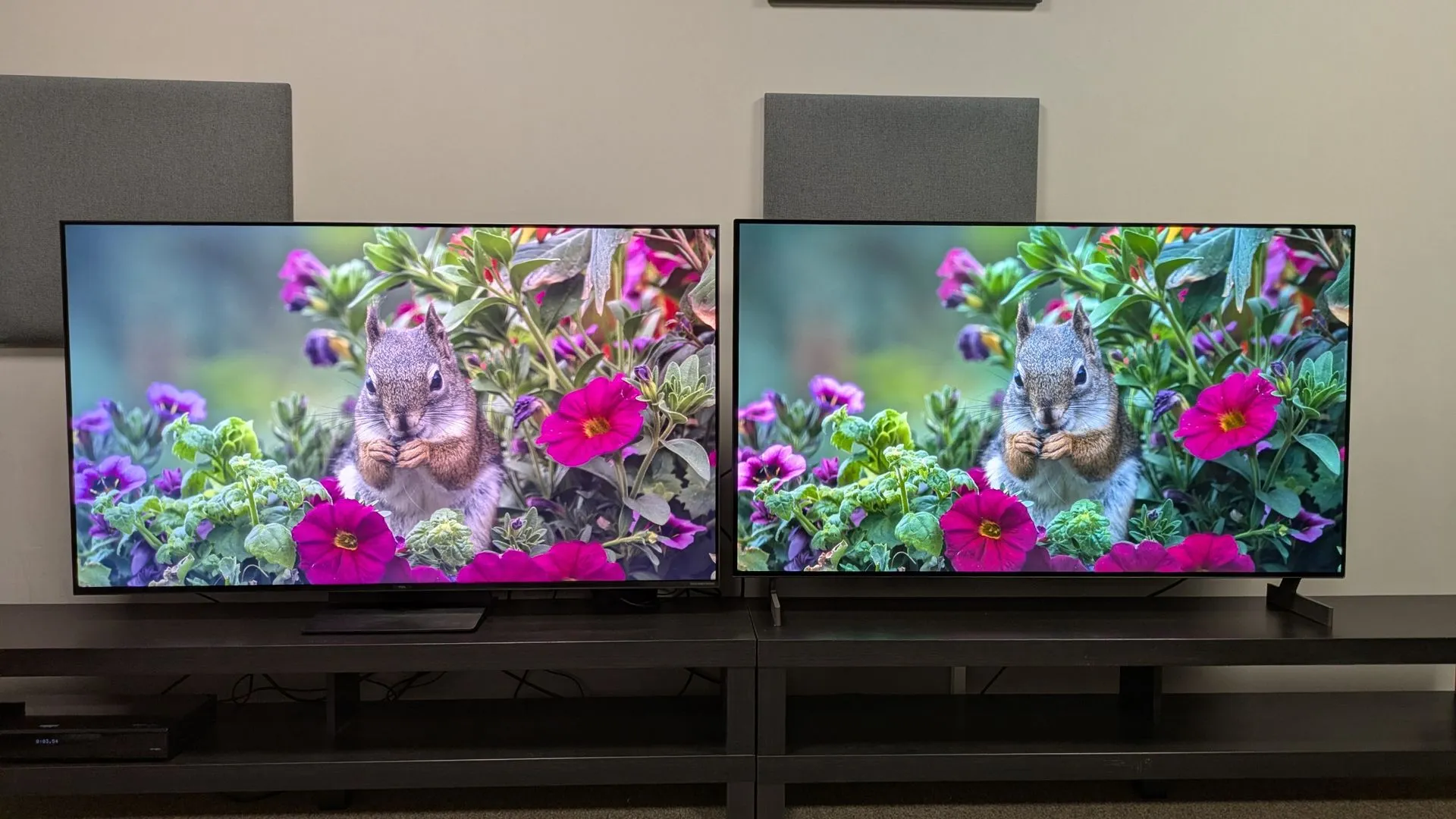
The TCL C7L demonstrates a significant luminance advantage over the LG B6E, making it much better suited for bright-room viewing. While entry-level OLED technology has seen improvements—with the LG B6E reaching 808 nits in Filmmaker Mode compared to the 668 nits of its predecessor, the B5—it cannot match the raw power of the mini-LED panel.
During testing, the TCL C7L achieved a peak HDR brightness of 2,083 nits in Filmmaker Mode. This massive gap was highly visible in real-world applications. For instance, when viewing desert landscapes in Lawrence of Arabia, the white sands and blue skies on the TCL model felt much more impactful and dazzling. In contrast, the LG B6E appeared noticeably dimmer, even when switched to Cinema Home mode to boost its output.
Impact of brightness on HDR highlights
High dynamic range (HDR) relies on the ability to make bright objects pop against darker backgrounds. In scenes from Speed Racer, the brilliant white of the Mach 5 vehicle was significantly punchier on the TCL C7L. Although the difference in luminance was less extreme in this specific title than in the desert scenes of Lawrence of Arabia, the TCL's ability to drive high-intensity highlights remains a core strength of the mini-LED architecture.
Which technology offers better contrast and dark scene handling?
OLED remains the superior choice for dark-room viewing and deep black tones due to its ability to turn off individual pixels. The LG B6E excels in high-contrast scenes, such as those found in Project Hail Mary, where it produces consistently rich and deep blacks throughout space sequences. This self-dimming capability allows for precise borders between light and dark elements.
While the TCL C7L provides impressive black levels for a mid-range mini-LED, it is still subject to the limitations of a backlit system. In scenes featuring stars in space, the C7L occasionally exhibited blooming—a phenomenon where light bleeds into surrounding dark areas. While this blooming is less aggressive than in previous TCL generations, it is still a factor during dimmed-room viewing.
However, the comparison between the two is not entirely one-sided. In movies like The Batman, which feature very low brightness levels and heavy shadows, the LG B6E can sometimes suffer from "crushed" blacks, where subtle shadow details, such as a subway platform wall, become difficult to distinguish. The TCL C7L actually offered better legibility in these specific instances, showing more detail in the dark crevices of the Batcave, even if it occasionally struggled with blooming behind bright objects.
How do color reproduction and accuracy differ?
Both the TCL C7L and the LG B6E deliver vibrant color profiles, but they approach saturation and depth differently. The TCL C7L tends to produce punchier, more shimmering colors due to its higher peak brightness, making it excellent for animated content like The Super Mario Galaxy Movie. Conversely, the LG B6E offers a richer, more three-dimensional color profile, providing more depth to characters and objects.
The choice between these two often comes down to personal preference regarding color temperature and specific hues:
- TCL C7L: Excels in rendering yellows and oranges; offers more accurate, cooler color temperatures.
- LG B6E: Provides more depth in reds and greens; offers a richer, more "solid" look to colors.
A notable finding during testing was the color temperature consistency. The LG B6E exhibited a slight green tint in certain scenes, most notably during a subway sequence in The Batman. While this might not be obvious in isolation, it was clearly visible when placed next to the more color-accurate, cooler tones of the TCL C7L. Despite this, the LG's ability to make colors feel more "true-to-life" in certain natural settings, such as the grass in Speed Racer, remains a significant advantage for many viewers.
Which TV is the best buy for your specific setup?
Determining the winner depends entirely on the lighting conditions of your room and your preferred viewing habits. The TCL C7L is the clear victor for users who primarily watch TV in bright living rooms or those who prioritize high-impact HDR highlights and vibrant, punchy colors.
The LG B6E is the better investment for cinema enthusiasts who prefer watching movies in dark or dimmed environments. If you value perfect black levels, deep contrast, and a rich, three-dimensional color profile above all else, the OLED technology provided by LG offers a more refined experience for moody, atmospheric films.
Frequently asked questions
Is mini-LED better than OLED for bright rooms?
Yes, mini-LED is generally superior for bright rooms. As seen in the comparison between the TCL C7L and LG B6E, the mini-LED's ability to reach much higher peak brightness (over 2,000 nits) allows it to overcome glare and maintain visibility much more effectively than OLED.
Does OLED have better black levels than mini-LED?
OLED provides better black levels because it uses self-dimming pixels that can turn off completely. While mid-range mini-LEDs like the TCL C7L have improved significantly, they can still suffer from "blooming," where light leaks into dark areas, a problem OLED avoids entirely.
Can mini-LED TVs show more detail in shadows?
In some cases, yes. While OLED is famous for blacks, it can occasionally "crush" shadows, making dark details disappear. Testing showed that the TCL C7L could sometimes provide better legibility in very dark scenes, such as the shadows in The Batman, compared to the LG B6E.
Is there a significant brightness difference between 2024 and 2026 OLEDs?
There is a noticeable increase, but it is not as massive as the gap between mini-LED and OLED. For example, the LG G4 (2024) reached 1,489 nits, while the G6 (2026) reached 2,475 nits. However, entry-level OLEDs like the B6E still lag far behind high-end mini-LEDs in raw luminance.
Which TV is better for animated movies?
Both are excellent, but they offer different aesthetics. The TCL C7L is ideal for viewers who want shimmering, punchy, and extremely bright colors. The LG B6E is better for those who prefer a richer, more saturated, and three-dimensional color depth.
Key takeaways
- The TCL C7L mini-LED achieves 2,083 nits, significantly outperforming the LG B6E's 808 nits.
- LG's OLED technology provides superior black levels and better performance in dark rooms.
- TCL's mini-LED is better for bright-room visibility and high-impact HDR highlights.
- OLED can sometimes "crush" shadow details, whereas mini-LED may show light blooming.
- Color preference varies: TCL offers punchy brightness, while LG offers richer depth.
Conclusion
The choice between mini-LED and OLED is no longer a simple matter of one being "better" than the other; it is a choice of viewing environment and aesthetic preference. The TCL C7L proves that mini-LED technology is the king of brightness and daylight visibility, making it a powerhouse for versatile living rooms. Meanwhile, the LG B6E demonstrates that OLED remains the gold standard for contrast and immersive dark-room cinema. Ultimately, your decision should rest on whether you value the dazzling impact of high luminance or the perfect, infinite contrast of self-dimming pixels.