
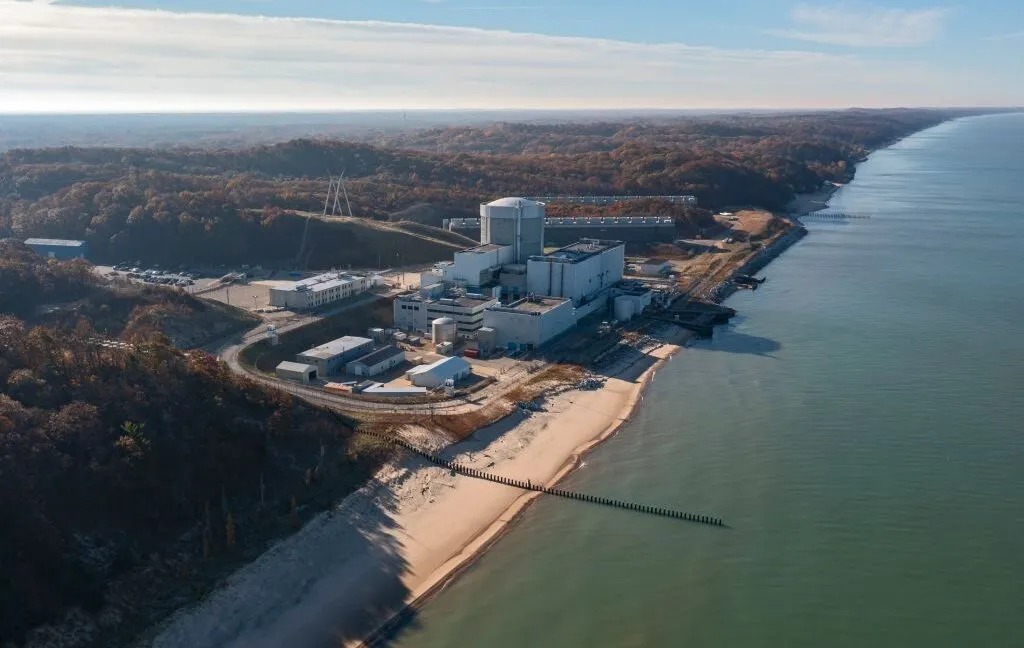
What safety incidents occurred at the Palisades facility?
Recent operational lapses at the Palisades nuclear power plant have drawn intense scrutiny from federal regulators. In August, a bundle of nuclear fuel rods tilted over during a refueling operation, an event that delayed the anticipated timeline for reopening the shuttered reactor. This incident follows a more serious event last year where a contractor fell into a reactor cavity. According to incident reports, the worker ingested water and required medical attention; while decontamination was performed, radiation protection personnel detected 300 counts per minute in the individual's hair.
Beyond physical accidents, the NRC identified significant issues regarding personnel competency and regulatory compliance. During inspections conducted in July and August, the NRC reported that nine out of 15 reactor operators at the Palisades site failed their initial license examinations. Only six individuals successfully secured their operator licenses during this period. These failures suggest a gap in the specialized training required to manage a nuclear facility safely during its transition back to active service.
The impact of technical failures on restart timelines
The technical difficulties encountered during refueling and operator training have direct implications for the project's schedule. Holtec International is working toward a March 2027 contractual deadline to begin supplying electricity to customers. The fuel rod incident, while described by Holtec as a "remarkable demonstration of technical ingenuity" during the recovery process, has already caused setbacks in what was intended to be the first successful reopening of a decommissioned US nuclear reactor.
Why did the NRC issue a warning to Holtec International?
The US Nuclear Regulatory Commission issued a formal warning to Holtec International due to what it described as a "chilled work environment" at the Palisades plant. This term refers to a workplace culture where employees feel hesitant to report safety concerns or operational irregularities due to a fear of professional retaliation. The NRC has demanded that Holtec address these cultural issues promptly to prevent further "cultural decline" within the affected departments.
The regulatory concern is compounded by the fact that Holtec is attempting a rapid transition from a component supplier to a full-scale reactor operator. Allison Macfarlane, who served as NRC chair from 2012 to 2014, noted that the company is a "newbie" in the realm of plant operation. She expressed concern that the pressure to meet political and financial milestones might be fostering a "move fast and break things" mentality, which is fundamentally at odds with the slow, meticulous culture required for nuclear safety.
How does the AI boom influence nuclear energy policy?
The drive to revitalize the US nuclear sector is heavily linked to the massive energy requirements of the burgeoning artificial intelligence industry. The Trump administration has positioned nuclear energy as a strategic necessity in the global AI race against China. To facilitate this, the administration has implemented policies aimed at slashing regulation and providing tens of billions of dollars in federal funding to accelerate nuclear projects.
This political push has created a high-pressure environment for companies like Holtec. The Palisades project has already secured approximately $2.2 billion in government support, and customers have secured an additional $1.3 billion in federal funds specifically to purchase power from the plant once it is operational. Critics argue that this convergence of intense energy demand and massive financial subsidies may be incentivizing speed over safety, potentially increasing the risk of industrial accidents.
What are the financial implications for the nuclear sector?
Despite the massive government investment, the broader nuclear energy market has experienced significant volatility as investor sentiment shifts. In the past year, more than $30 billion has been removed from the market value of five major US-listed nuclear energy companies: Oklo, Centrus Energy, BWX Technologies, NuScale, and Nano Nuclear. This decline is largely attributed to concerns that the initial AI-driven surge in energy demand might be slowing.
Holtec International is also feeling the effects of this market instability. The company was recently forced to postpone a planned initial public offering (IPO) that was expected to raise $900 million and value the New Jersey-based firm at up to $10 billion. These financial headwinds come at a critical time as Holtec attempts to transform its business model while simultaneously managing the complex technical and regulatory challenges of the Palisades restart.
Holtec's history of governance and legal challenges
The current regulatory scrutiny is not the only challenge facing Holtec. The company has a history of governance questions, including being the target of whistleblower lawsuits and legal disputes involving former executives. These legal battles have involved allegations ranging from financial misrepresentation to executive retaliation and fraudulent practices. While Holtec's founder and CEO, Kris Singh, has rejected these claims, the ongoing legal and regulatory issues add a layer of complexity to the company's mission to lead the US nuclear resurgence.
FAQ: Palisades Nuclear Restart
What is the current status of the Palisades reactor?
The Palisades reactor, which was decommissioned in 2022, is currently undergoing a restoration process led by Holtec International. The company is aiming to begin supplying power to customers by March 2027, though recent safety incidents and regulatory warnings have complicated this timeline.
Has there been any radiation exposure at the plant?
While the NRC stated there is no immediate risk to the public, a worker involved in a fall into the reactor cavity last year was decontaminated after radiation protection personnel detected 300 counts per minute in their hair. Holtec maintains that the worker sustained only minor injuries.
Who is funding the Palisades restart project?
The project is heavily supported by the US government. Holtec has secured approximately $2.2 billion in government support, and the Department of Energy provided a $1.5 billion loan in 2024 to help finance the restoration of the facility.
What is a "chilled work environment" in a nuclear context?
A "chilled work environment" is a regulatory term used by the NRC to describe a workplace where employees are afraid to report safety concerns. This fear of retaliation can lead to a decline in safety culture and an increased risk of accidents.
How does AI demand affect nuclear energy?
The rapid growth of artificial intelligence requires massive amounts of reliable, constant electricity. This has driven US policy to prioritize nuclear energy as a solution to meet the energy needs of data centers, leading to increased funding and regulatory shifts.
Key takeaways
- The NRC warned Holtec of a "chilled work environment" at the Palisades plant.
- A worker fell into a reactor cavity last year, resulting in radiation detection.
- A fuel rod bundle tilted during refueling, causing operational delays.
- Nine of 15 reactor operators failed their initial license examinations.
- Holtec aims to begin power supply by the March 2027 deadline.
The balance between speed and safety in nuclear energy
The situation at the Palisades nuclear power plant encapsulates the tension between rapid industrial scaling and the rigorous requirements of nuclear safety. As the United States seeks to leverage nuclear energy to power the AI revolution, the pressure to deliver results quickly is immense. However, the warnings from the NRC and the recent technical failures serve as a reminder that in the nuclear sector, the cost of error is uniquely high. The success of the Palisades restart will depend not just on technical ingenuity, but on Holtec's ability to rebuild a culture of safety that can withstand political and financial pressures.




