
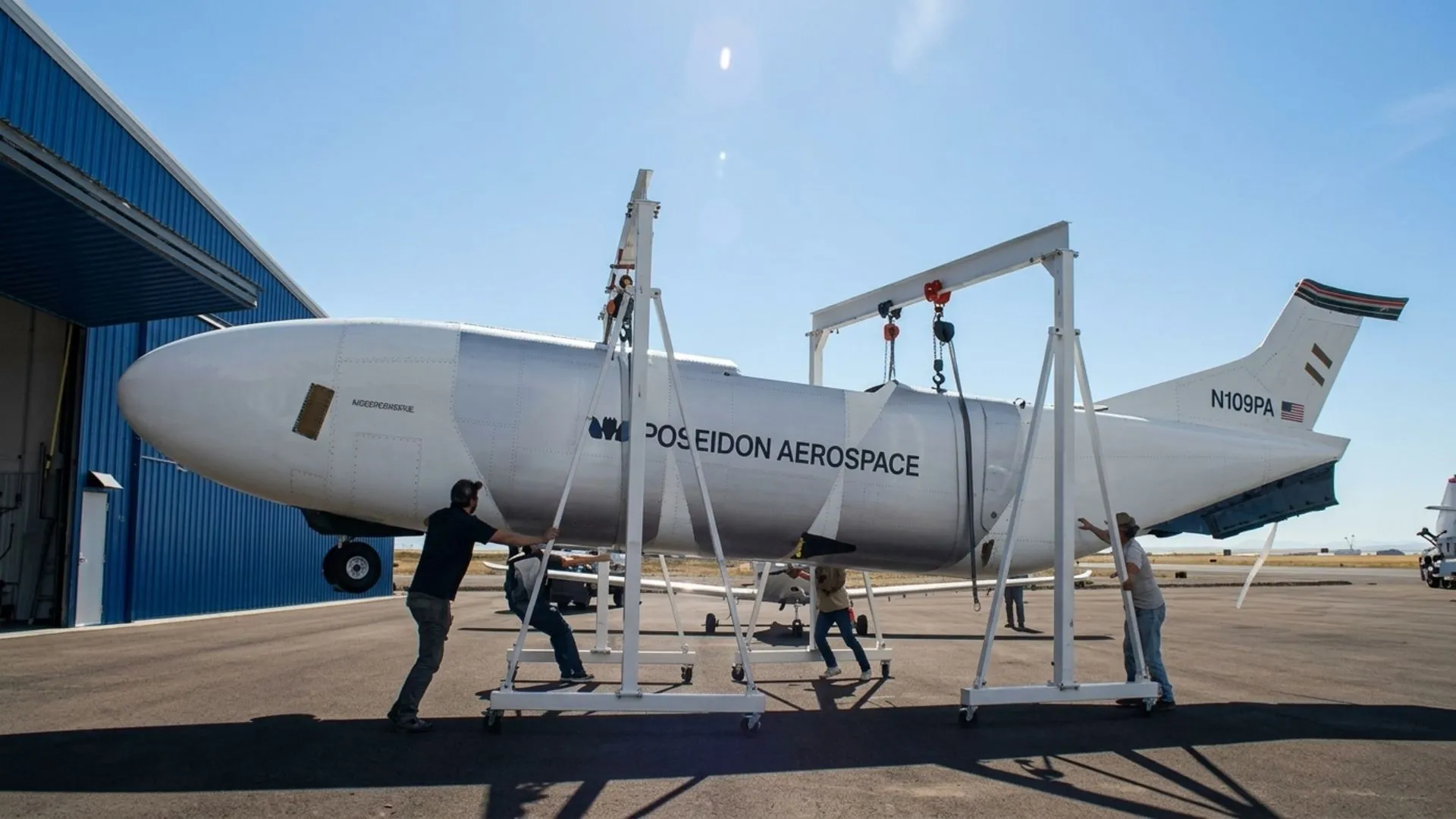
What makes the Egret drone design unique for cargo transport?
The Egret drone is engineered specifically around the requirement of unmanned freight transport rather than being a modified version of a piloted aircraft. By eliminating the cockpit, the design maximizes internal volume and reduces the structural weight typically required to house a human pilot and associated life-support or flight control equipment. This focus on payload efficiency allows the 50-foot wingspan aircraft to carry up to 4,000 pounds of freight.
According to Poseidon Aerospace, the aircraft is intended to function as an "airborne equivalent of trucking." This concept seeks to move shipments between locations with the same economic efficiency seen in ground-based autonomous logistics. Because the internal space is not divided between a flight deck and a cargo hold, the aircraft can dedicate nearly its entire structural capacity to goods.
The structural advantages of removing the cockpit
Removing the cockpit provides two primary advantages: volume and weight. In conventional aircraft, a significant portion of the fuselage is dedicated to the pilot's seat, visibility requirements, and safety systems. In the Egret, this space is reclaimed for cargo, increasing the density of goods that can be moved per flight. Furthermore, the reduction in weight from removing heavy cockpit components and human-centric safety gear allows for a higher payload-to-weight ratio, which is critical for lowering the cost per pound of transported freight.
How does remote operation work without an onboard pilot?
While the Egret is designed for autonomous flight, it does not operate entirely without human oversight, particularly during its initial testing and control phases. Instead of a pilot sitting inside the aircraft, Poseidon Aerospace utilizes a ground control station to manage flight operations. This setup relies on live camera feeds and remote access to essential flight controls.
Remote operators can manage critical flight surfaces and engine functions, including:
- Throttle control
- Flaps adjustment
- Rudder positioning
- Other primary flight surfaces
This separation of the pilot from the aircraft ensures that human expertise is available for complex maneuvers or emergency responses while the aircraft remains unmanned. However, the company must still validate the reliability of its communication links and flight control systems to ensure that the transition from remote human control to fully autonomous operational conditions is seamless and safe.
What is the development history of Poseidon Aerospace?
The development of the Egret is the result of iterative testing and the expertise of specialists in logistics and mechanical engineering. The company was co-founded by David Zagaynov, a former Amazon engineer with a focus on logistics, and Parker Tenney, a mechanical engineering graduate with experience at Lockheed Martin. This combination of expertise aims to bridge the gap between high-level logistics efficiency and advanced aerospace engineering.
The path to the Egret involved several developmental milestones and prototypes:
- V0 Prototype: The company's initial prototype, which underwent multiple redesigns before achieving a successful test flight.
- Seagull Prototype: A quarter-scale model of the Heron aircraft, built with a lightweight carbon-fiber structure specifically for water operations.
- Demonstration Success: The Seagull has already been used in demonstrations for various high-level organizations, including the Navy, Special Operations Command, and the Department of War.
These preliminary stages have provided the foundational data necessary to move toward the larger, more capable Egret platform, which is expected to undergo testing in Oregon.
How will the $60 million funding impact autonomous aviation?
Poseidon Aerospace has secured $60 million in Series A financing to accelerate its development of autonomous aviation technology. This funding round was led by TQ Ventures and is earmarked for the continued advancement of the Egret and other autonomous flight projects. The capital infusion is a significant signal of investor confidence in the potential for unmanned cargo aircraft to disrupt traditional logistics models.
Despite the substantial funding, several technical questions remain regarding the commercial viability of the Egret. Currently, there is no public data regarding:
- The aircraft's maximum operational range
- Cruising speeds and flight efficiency
- Specific fuel consumption rates
- Projected operating costs per flight
As the company moves into its testing phase in Oregon, these metrics will become critical. Proving that the Egret can operate more cheaply than traditional freight methods will be the ultimate test of its success in the global logistics market.
Frequently asked questions
What is the payload capacity of the Poseidon Aerospace Egret?
The Egret is designed to carry a payload of up to 4,000 pounds. Its design prioritizes this capacity by utilizing a 50-foot wingspan and removing the traditional cockpit to maximize internal cargo volume and minimize unnecessary weight.
Who is developing the Egret drone?
The aircraft is being developed by Poseidon Aerospace, a company co-founded by David Zagaynov, a former Amazon logistics engineer, and Parker Tenney, a mechanical engineering graduate formerly of Lockheed Martin. Their expertise combines logistics and aerospace engineering.
Will the Egret be fully autonomous from the start?
No, the aircraft will not be fully autonomous during its initial phases. It will be operated via a ground control station using live camera feeds, allowing remote operators to manage throttle, flaps, and rudders while the company validates its reliability.
Where will the Egret undergo its testing?
Poseidon Aerospace plans to conduct testing for the Egret in Oregon. If successful, the aircraft is expected to become the largest cargo drone currently being flown within the United States.
What previous prototypes has the company built?
Poseidon Aerospace previously developed the V0 prototype, which required several redesigns, and the Seagull, a quarter-scale carbon-fiber prototype designed for water operations. The Seagull has been demonstrated to the Navy and Special Operations Command.
Key takeaways
- The Egret drone features a 50-foot wingspan and a 4,000-pound payload capacity.
- The aircraft design eliminates the cockpit to maximize cargo space and reduce weight.
- Remote operators control the drone via ground stations using live camera feeds.
- Poseidon Aerospace raised $60 million in Series A funding led by TQ Ventures.
- The drone is being developed by former Amazon and Lockheed Martin engineers.
The future of unmanned freight logistics
The development of the Poseidon Aerospace Egret represents a significant shift toward specialized, unmanned logistics platforms. By treating the aircraft as an "airborne truck," the company is addressing the fundamental need for cost-effective, high-capacity freight movement. While the technical challenges of range, speed, and total autonomy remain to be proven in flight testing, the combination of significant Series A funding and a design focused on payload efficiency suggests a serious contender in the evolving landscape of autonomous aviation. The success of the upcoming Oregon tests will likely determine the scale of its impact on international logistics.